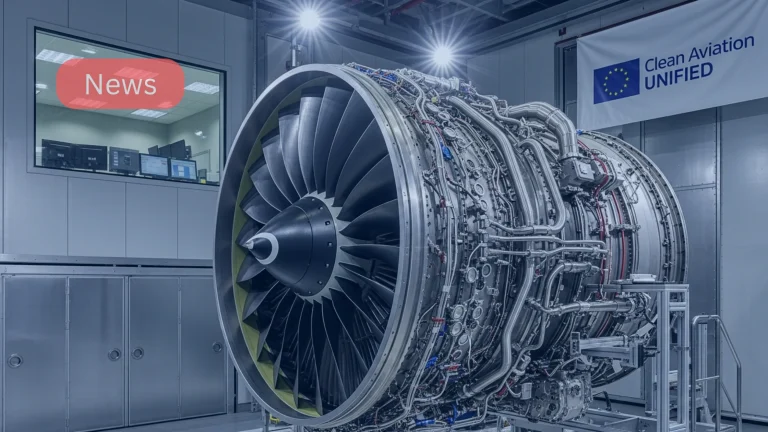
Rolls‑Royce has confirmed that the Pearl 10X engine, earmarked to power the ultra‑long‑range Dassault Falcon 10X, has successfully completed all major engine certification tests, according to CEO Tufan Erginbilgic, speaking on July 31, 2025.
The news marks a pivotal moment in business aviation propulsion development. With flight trials now wrapped up, Rolls‑Royce is set to submit certification reports to regulators in the coming months. Last year, the company delivered the first Pearl 10X engine to Dassault in preparation for the Falcon 10X’s maiden flight, though Dassault has not yet announced a launch date for the airframe itself.
Rolls‑Royce’s Pearl family includes the Pearl 15, powering Bombardier’s Global 5500/6500, and the Pearl 700, fitted to Gulfstream’s G700 and G800. The Pearl 10X, by contrast, is the most powerful business‑jet engine in the family, exceeding the G700’s 18,250 lb thrust rating.
Previous reporting by FlightGlobal indicates that the development program has accumulated more than 3,400 test hours, including early ground and flight testing of the Advance2 demonstrator core, with most certification milestones now complete. Only one remaining major test, an emissions performance evaluation, is yet to be finalized before full regulatory submission.
From Testbed to Certification
Rolls‑Royce’s bespoke Boeing 747‑200 Flying Test Bed was used extensively to validate the Pearl 10X across various altitudes and operational envelopes. The modified 747 flew over 25 sorties, reaching test altitudes up to 45,000 ft, enabled by a mix of installed engine types including RB211s and a high‑thrust Trent 1000 variant that provided supplemental lift.
Philipp Zeller, senior vice‑president for Dassault’s business aviation operations within Rolls‑Royce, confirmed that the Pearl 10X capitalizes heavily on the Advance2 core architecture originally developed for earlier Pearl variants. Many certification data points were reusable, although new tests were required for bespoke hardware like the nacelle, mount, and software aligning to the Falcon 10X’s specific integration requirements.
CEO Erginbilgic emphasized that Rolls‑Royce’s advanced digital tools, including simulations, digital twins, and predictive modeling, have helped ensure the flight test outcomes closely matched forecasted engine performance, indicating strong confidence in their design process.
What Remains Before the Falcon 10X Can Fly
While certification is near, one major engine certification test remains: emissions compliance. Completion of this final hurdle is expected in the “coming months,” after which regulator submissions to bodies like EASA and FAA will occur.
Additionally, Dassault has yet to announce the Falcon 10X’s first flight schedule, although plans for first deliveries remain pointed toward service entry in 2027, implying airframe flight tests may begin later in 2025 or early 2026.
Industry Implications
The Pearl 10X’s certification would position Rolls‑Royce strongly in the high‑end business jet market. Dassault’s Falcon 10X is expected to compete head‑to‑head with Gulfstream’s G700/G800 and Bombardier’s Global 7500 in range, efficiency, and premium performance.
Rolls‑Royce’s Dahlewitz facility in Germany, which assembles its Pearl family engines, including the Pearl 10X and Pearl 700, recently celebrated delivering its 9,000th turbofan. This benchmark illustrates the scale and maturity of the business‑jet engine production line and serves as a pillar for future growth ambitions.
Bottom Line
Rolls‑Royce appears on track to close out certification testing of its most powerful business‑jet engine to date. With major engine tests complete and final emissions certification pending, the Pearl 10X is now entering its final regulatory phase ahead of the Falcon 10X’s first flight, still expected ahead of its planned 2027 entry‑into‑service schedule.
Citation Note: This article is based on Aviation Week reporting by Robert Wall (July 31, 2025) Aviation Week Network, with corroboration from AIN Online and FlightGlobal on certification status, testing hours, and program context.