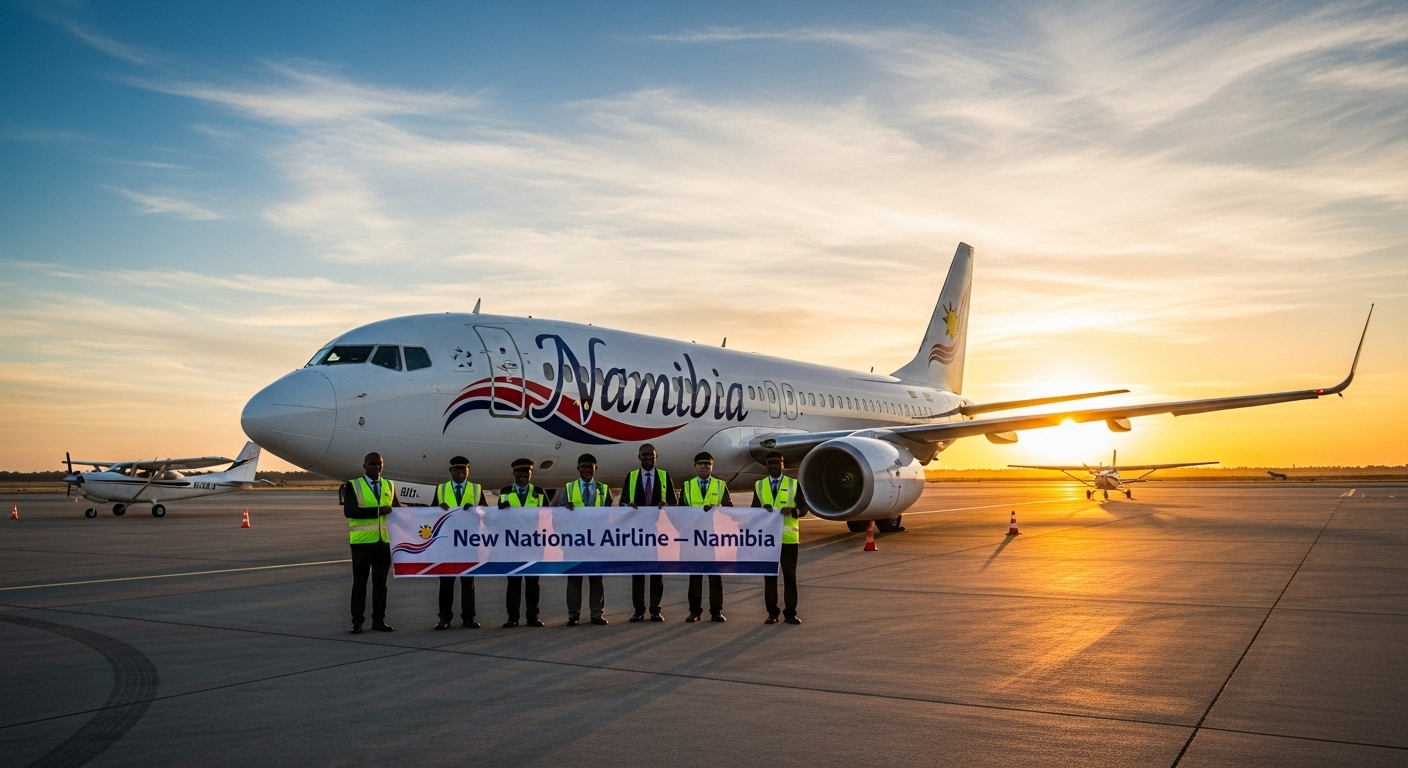

Namibia’s government has committed to establishing a Namibia new national airline, opting to build a fresh, sustainable carrier from scratch rather than revive the defunct Air Namibia, Works and Transport Minister Veikko Nekundi told local media. The statement, first summarized by Aviation Week and reported in New Era, said negotiations with potential investors should conclude by December 2025 and that the new airline could begin operations between June and December 2026.
The development marks a high-stakes effort to restore a national air connector after Air Namibia’s liquidation in 2021. Government officials framed the initiative as a public-private partnership (PPP) aimed at avoiding past mismanagement and creating a commercially viable carrier to support tourism, trade and regional connectivity. Aviation Week’s reporting and regional outlets describe the move as a cautious restart, one that emphasizes sustainability and private capital.
What the government said (who, what, when, where, why)
- Who: Namibian government (Works & Transport Minister Veikko Nekundi), working with prospective private partners.
- What: Plan to create a new national airline as a public-private partnership, explicitly not a revival of the Air Namibia brand.
- When: Negotiations expected to conclude by December 2025, with launch and initial operations targeted between June–December 2026 (government timeline). These are target dates and subject to investor agreements.
- Where: Headquarters and primary hub expected in Windhoek (Hosea Kutako International Airport) to serve regional and international markets.
- Why: To restore national air connectivity, support tourism and trade, and correct the governance failures that plagued Air Namibia. Officials cited the need for sustainable, accountable ownership and operations.
Background: Air Namibia’s collapse and lessons learned
Air Namibia, Namibia’s former flag carrier, entered voluntary liquidation in 2021 after decades of state bailouts that left it insolvent. The airline’s closure cost taxpayers significant sums and prompted political debate about the role of state ownership in national airlines. Government officials now argue the new model must avoid the governance, oversight and financial pitfalls that doomed its predecessor.
This context explains why the government insists the new carrier will be a new entity, with a clear PPP structure and commercial governance, rather than a reconstituted Air Namibia. Reuters and regional reports from SABC and ch-aviation note the repeated emphasis on sustainability and investor oversight.
What the report says about financing and investors
Aviation Week reports the government has opened negotiations with potential private investors, aiming to conclude talks by December 2025 and finalize an ownership structure. However, Aviation Week and local media did not publish confirmed investor names or deal terms, meaning financing and governance specifics remain to be announced. Aviation analysts note that credible private capital and realistic business plans will be essential to avoid the fiscal drain that accompanied Air Namibia.
Strategic rationale: routes, fleet and regional context
Namibia’s geographic position and tourism potential (safari, coastal, and adventure tourism) make a national carrier strategically appealing for inbound visitor flows and regional connectivity. Industry observers expect an initial focus on regional African routes and key international markets such as South Africa and Europe, with later expansion dependent on route economics and rights. The government explicitly signals a stepwise approach: establish a sound domestic/regional base, then assess long-haul ambitions once the carrier’s commercial footing is proven.
Aircraft choices will reflect route strategy and cost discipline. Analysts suggest narrowbodies (e.g., A320 family, 737NG/MAX) or regional jets could be rational early choices to build network density before any larger widebody ambitions. However, the government has not disclosed fleet plans.
Regional and regulatory issues
Establishing a new flag carrier requires regulatory approvals (air operator certificate, traffic rights), bilateral air services negotiations for international routes, and compliance with ICAO safety and governance standards. The government’s timeline assumes these processes, and any necessary bilateral negotiations, proceed without major obstacles. Aviation Week cautions that regulatory sequencing and bilateral agreements can be time-consuming and may affect launch schedules.
Reactions and expert commentary
Initial reaction among industry watchers is cautiously optimistic. Some aviation analysts welcome the government’s pledge to pursue a PPP and to avoid reviving the old, debt-laden brand. Others warn that national carriers are difficult to sustain without consistent demand, strong management, and realistic commercial assumptions, particularly for countries with small domestic markets. Regional outlets and trade analysts emphasize the need for transparent investor selection and credible business plans to attract long-term financing.
Risks and downside scenarios
- Financing risk: Without committed private capital and sound financial modeling, the project could stall, or revert to costly state support.
- Market risk: Namibia’s domestic market is small; success will hinge on regional feeder traffic and effective partnerships (codeshares, interlines).
- Regulatory and bilateral constraints: Securing traffic rights and international slots may limit immediate route ambitions.
What’s next? timeline and monitoring
- By Dec 2025: Government expects investor negotiations to conclude. Watch for named investors, ownership structures, and memoranda of understanding.
- H1–H2 2026: If agreements finalize, the government targets launch and first commercial operations between June and December 2026. Key near-term indicators include OPA (operator) filings, fleet commitments or leases, and regulatory certifications.
- Medium term: Successful first year operations and the second phase of fleet/routing expansion will indicate durable commercial viability.