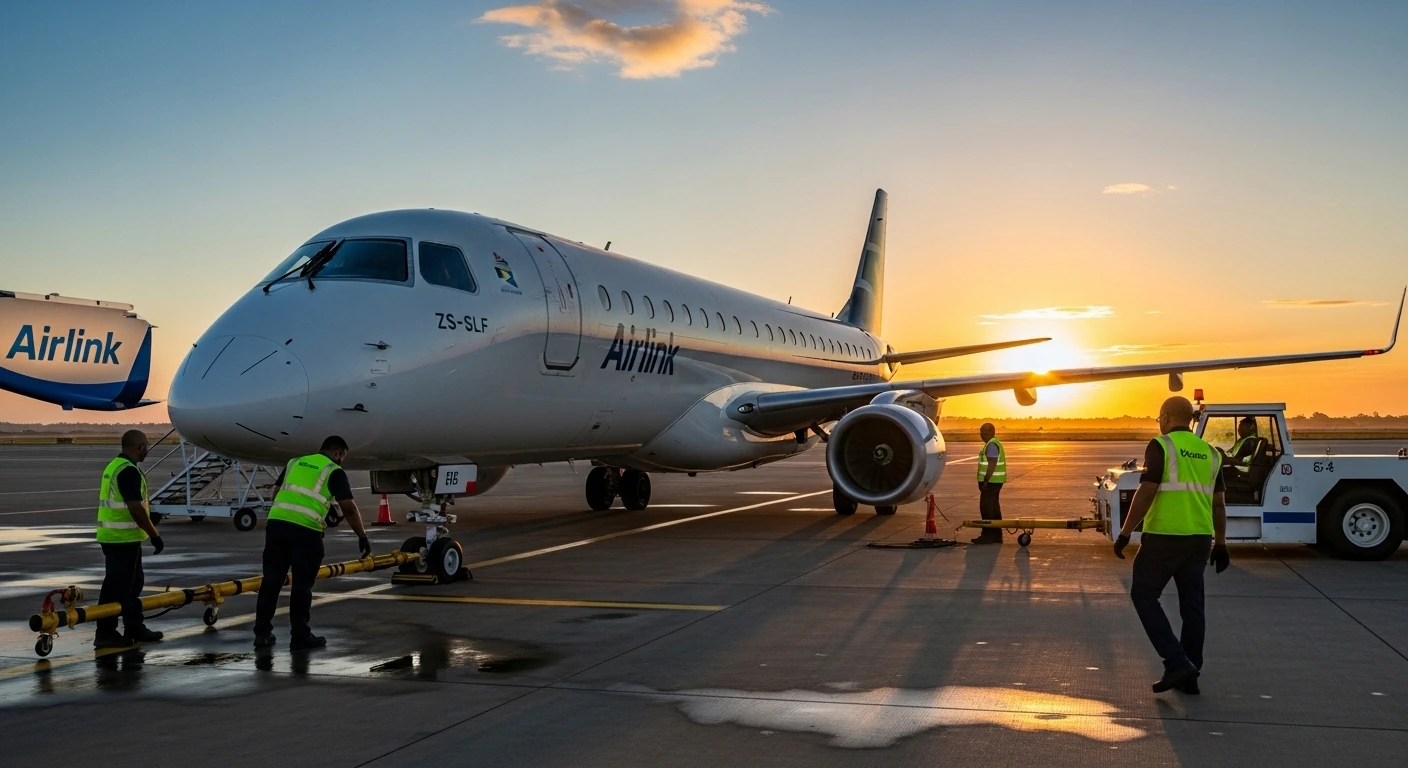

Brazilian planemaker Embraer said on 3 September 2025 that the South African Civil Aviation Authority (SACAA) has granted type-acceptance certification for its E-Jet E2 family, the E190-E2 and E195-E2, clearing a key regulatory hurdle for commercial operation in South Africa and broader southern Africa. The approval coincides with Airlink’s lease agreement to bring 10 E195-E2s into its fleet, a move Embraer and the airline say will expand capacity and improve efficiency on regional routes.
What the approval covers and why it matters
Type acceptance from SACAA means that the regulator has reviewed evidence and accepted the E190-E2 and E195-E2 as meeting applicable South African airworthiness standards, enabling those models to be registered and operated under South African certificates. Embraer hailed the move as a major step for the E2 family in Africa; the manufacturer noted the E2s’ improved fuel efficiency and passenger capacity compared with previous-generation E-jets.
The practical importance is immediate for operators and lessors: with local certification in place, airlines can accept deliveries, register aircraft locally, and begin crew training and route planning geared to E2 performance characteristics. For Airlink, the certification aligns with its lease from Azorra for 10 E195-E2s, aircraft that the carrier says will support higher-density and emerging routes across sub-Saharan Africa.
What Embraer and Airlink said
Embraer’s statement quoted company executives emphasizing market fit and operational flexibility. Stephan Hannemann, SVP for Africa & Middle East at Embraer Commercial Aviation, said the certification “opens new opportunities for the aircraft,” and highlighted the E2 family’s fuel-efficiency gains. Embraer quantified those gains in its release, the E190-E2 and E195-E2 deliver step improvements in fuel burn (manufacturer comparatives) versus prior generation E-Jets.
Airlink’s CEO, De Villiers Engelbrecht, said SACAA’s type acceptance was an important milestone as the airline prepares to receive and operate the E195-E2s. Airlink and Azorra have said deliveries will start later in 2025 and continue through 2027, enabling the carrier to expand frequencies and serve longer or higher-traffic sectors across southern Africa.
The commercial backdrop: leases, deliveries and Africa’s fleet mix
Airlink’s lease of ten E195-E2s from Azorra, announced earlier in 2025 and reiterated in company and industry releases, is the most immediate commercial manifestation of the SACAA approval. Embraer and market reporting indicate that the E195-E2 seats up to roughly 136 passengers in a two-by-two layout and offers range and performance that suit a mix of short-haul and medium-density regional links. The planned deliveries will augment Airlink’s fleet and are timed to start later in 2025 and complete by 2027.
Beyond Airlink, the broader commercial picture shows growing demand in Africa for fuel-efficient single-aisle jets to replace older, less efficient types and to open new intra-regional services. Local registration and in-country support are critical factors for operators considering new types; SACAA certification removes one regulatory barrier.
Technical and supply-chain notes
Embraer’s E2 family incorporates aerodynamic improvements and new-generation engines to improve efficiency compared with earlier E-Jets. The E195-E2, the largest member of the family, typically seats between 120 and 132 passengers depending on configuration. For the South African certification process, the aircraft’s Pratt & Whitney PW1900G engines were cleared in parallel with the airframe, with Pratt & Whitney supporting Embraer’s efforts to secure approval from the South African Civil Aviation Authority (SACAA).
That said, the wider commercial timeline remains influenced by global production capacity and supply-chain constraints. Embraer has signalled production ramp-up ambitions, and recent commercial wins (such as a large Avelo order for E195-E2s and other deals) underline market momentum, but delivery schedules still depend on manufacturing capacity and lessor allocation.
Regional implications: ops, MRO and pilot training
The entry of E2s into South African service is likely to spur demand for local MRO capability, spares provisioning, and simulator/training capacity for pilots and maintenance technicians on the type. Embraer and Pratt & Whitney typically coordinate with local partners and authorised service centres to set up maintenance networks; such arrangements will be critical to ensure reliable operations and minimize downtime across the region. Operators and lessors commonly prefer local or regional support arrangements before committing to new-type deployments.
For pilot and crew training, the lead time before the first deliveries will be used to establish type-rating courses and maintenance training; airlines normally run joint programs with manufacturers and MROs to accelerate readiness. For Airlink, the E2s’ two-by-two seating economy and short-field performance are expected to be a commercial fit on some domestic and regional routes.
What analysts will watch
- Delivery fidelity: whether Embraer meets the planned delivery windows (first units later in 2025 through 2027 for Airlink) given continuing production pressures industry-wide.
- Operational economics: real-world fuel burn and maintenance costs in hot-and-high African operating environments, compared with Embraer’s published performance figures.
- MRO and spares network: how Embraer and partners scale support for the E2 family across southern and sub-Saharan Africa.