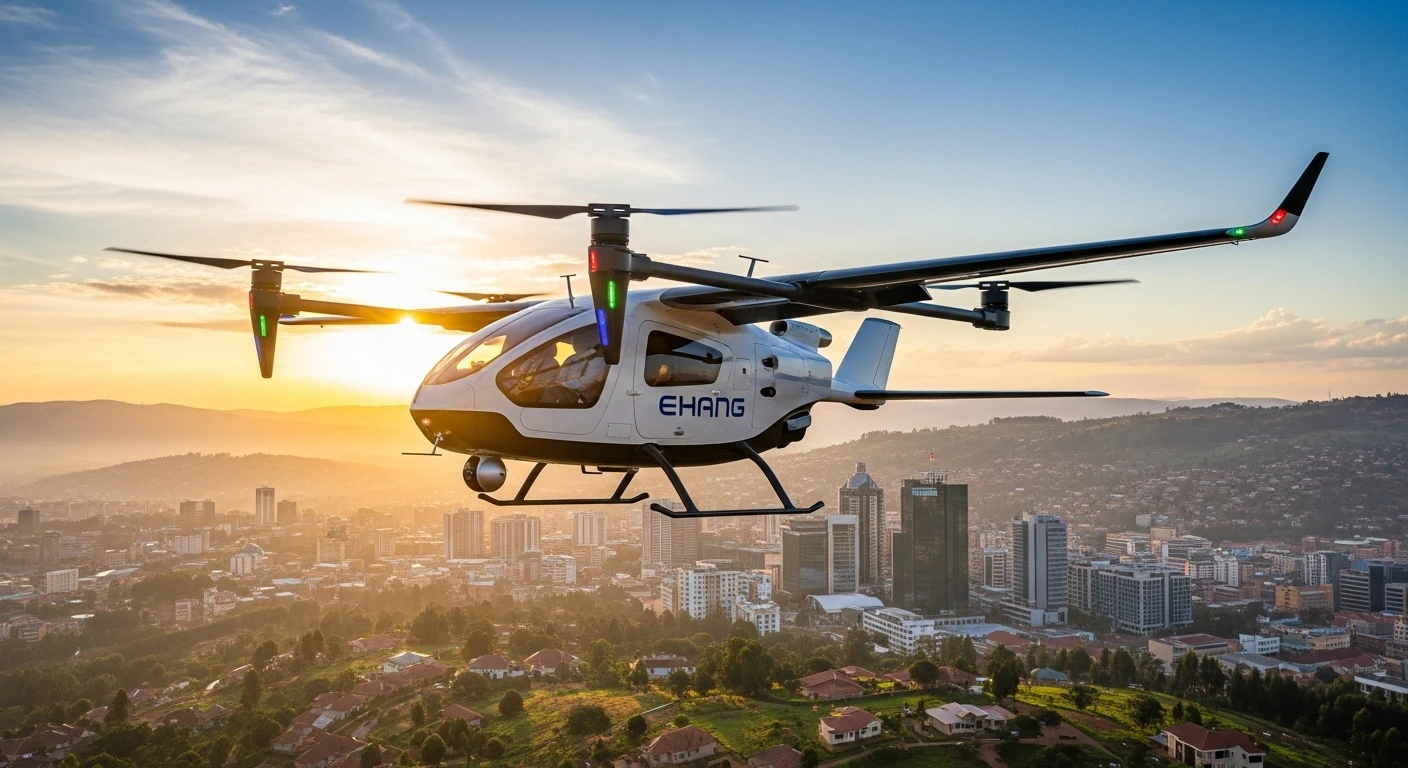

Rwanda Debuts Africa’s First Passenger Air Taxi
Rwanda has become the first African country to launch a passenger air taxi trial, testing the Chinese-made EHang EH216-S autonomous aerial vehicle (AAV) over Kigali. According to Business Traveller journalist George Gomez, the test flight marked a milestone in the continent’s adoption of urban air mobility technology.
Speaking at the launch, Rwanda’s Minister of Infrastructure highlighted the country’s ambition to lead Africa in aviation innovation, following its earlier success with Zipline’s medical drone delivery program. The EH216-S flew a short route under the supervision of Rwanda Civil Aviation Authority (RCAA) officials, demonstrating its potential for safe, autonomous passenger transport.
What Makes the EHang EH216-S Significant
- The EH216-S is a fully electric, two-seat eVTOL (electric vertical take-off and landing) aircraft, designed for short, low-altitude flights, and capable of being flown autonomously with no onboard pilot.
- It has a range of approximately 30-35 km and a maximum speed up to 100-130 km/h, depending on conditions.
- In 2023, the aircraft obtained its Type Certificate, Production Certificate, and Standard Airworthiness Certificate from the Civil Aviation Administration of China (CAAC), making it the first pilotless, passenger-carrying eVTOL to achieve these certifications.
- Rwanda’s trial marked the first public pilotless human-carrying flight of the EH216-S in Africa, performed in Kigali during the Aviation Africa Summit in September 2025.
Africa’s Growing Interest in Urban Air Mobility
Context and Policy: Urban air mobility (UAM) is gaining traction across Africa as cities seek solutions to congestion and underdeveloped ground transport infrastructure. The International Civil Aviation Organization (ICAO) has urged African states to begin regulatory preparations for unmanned aerial systems (UAS) and advanced air mobility. Rwanda is among the countries with formal or draft UAS regulations and has been a front-runner in allowing operational drone delivery programs, giving it an early advantage.
Regional Momentum
- South Africa has active commercial drone usage in mining, infrastructure surveying, medical and inspection services.
- Nigeria shows increasing interest in passenger-drone possibilities, although no public pilotless passenger drone flights are yet confirmed, and regulatory frameworks remain under development.
- Kenya and Ghana have strong drone delivery programs (e.g. medical supplies, vaccines), but no publicly documented passenger air taxi trials to date.
Rwanda’s recent trial of the EH216-S autonomous air taxi in Kigali could serve as a model for other African nations to accelerate regulatory frameworks, air traffic management (ATM) systems adapted to UAM, and the planning of infrastructure such as vertiports and aerial corridors.
Economic and Aviation Implications
If commercialized, air taxis could unlock:
- Tourism Boost: Rapid transfers from Kigali International Airport to hotels and convention centres.
- Medical Access: Fast patient transfers to King Faisal Hospital or remote clinics.
- Business Travel Efficiency: Reduced road congestion and quicker intercity links.
The Rwanda Development Board projects Kigali could see up to 500,000 passenger air taxi trips annually by 2035, creating a new market segment for Africa’s aviation industry.
Safety and Regulatory Considerations
While the EH216-S is certified in China, Rwanda’s regulators must adapt ICAO Annex 8 (Airworthiness) and Annex 6 (Operation of Aircraft) for autonomous passenger vehicles.
Industry analysts stress the need for:
- Pilotless Flight Oversight: Real-time monitoring by ground stations.
- Redundant Systems: Fail-safe mechanisms for GPS loss or power failure.
- Public Acceptance: Education campaigns to build trust in autonomous flight.
Rwanda’s Track Record with Innovation
This is not Rwanda’s first leap in aviation technology:
- 2016: First country to approve nationwide drone delivery (Zipline).
- 2020–2023: Expanded drone program to cover >90% of medical deliveries.
- 2025: Now first to trial passenger-carrying eVTOL in Africa.
This consistent track record strengthens Rwanda’s reputation as a testbed for emerging aviation solutions.
Industry Reaction
Aviation experts, including several at the African Airlines Association (AFRAA), praised Rwanda’s leadership. “This could catalyze a regional ecosystem for air taxi operations, MRO facilities, and skilled jobs in avionics and electric propulsion,” noted one Nairobi-based aviation analyst.
EHang, the manufacturer, stated it is “committed to working with Rwanda to develop commercial routes and vertiports as part of a scalable UAM network.”
What’s Next for Rwanda’s Air Taxi Project
The next phases of Rwanda’s project are expected to include:
- Route Trials: Expanding flights from demonstration to scheduled trials over key Kigali corridors.
- Regulatory Framework: Finalizing RCAA standards for passenger eVTOLs.
- Commercialization: Potential public launch before 2027 if safety milestones are met.
Africa’s air mobility future will depend on infrastructure investment, regulatory harmonization, and public confidence. If Rwanda succeeds, it could become the regional hub for advanced air mobility (AAM), drawing investment from OEMs and air mobility operators.