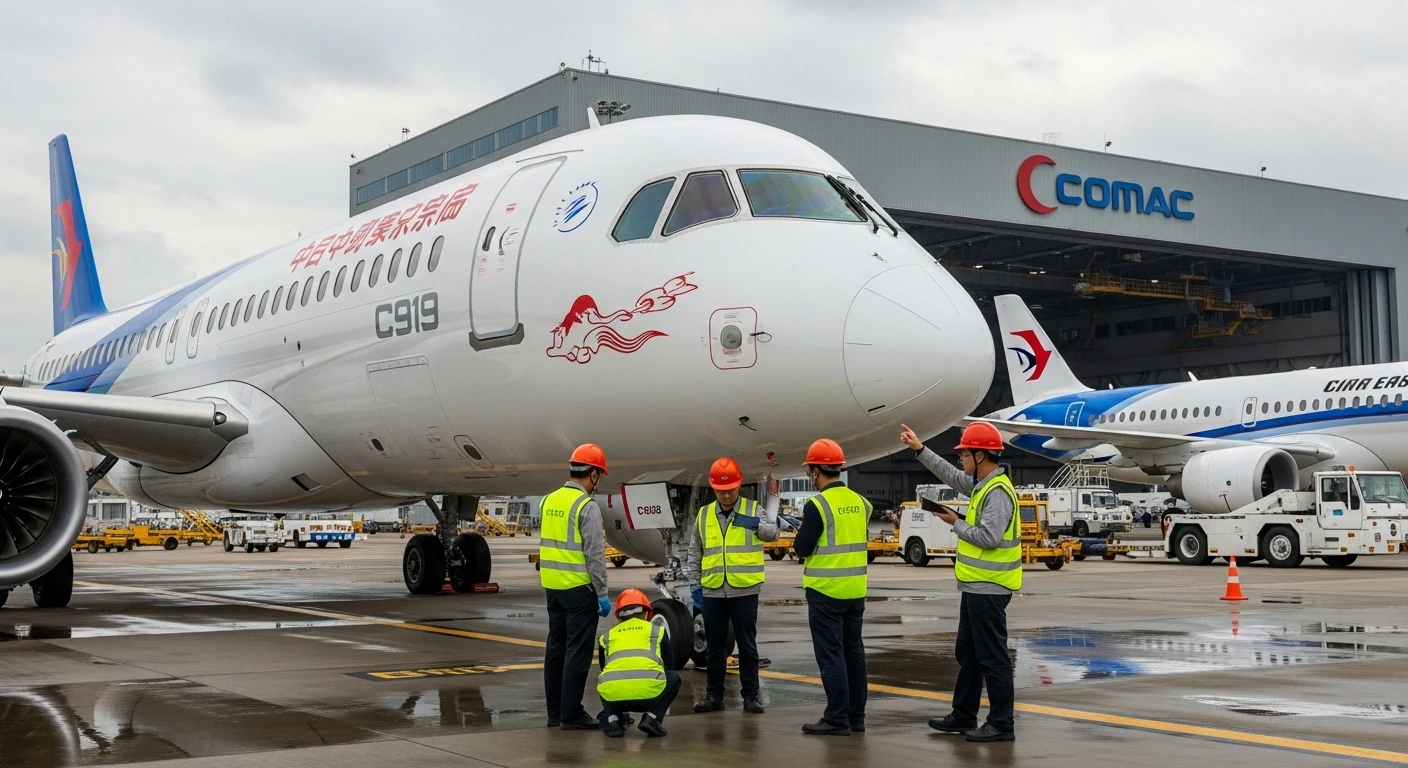

Chinese aircraft maker COMAC has fallen significantly behind its 2025 C919 delivery targets, according to a Reuters analysis of regulatory filings and industry data. Major Chinese carriers, China Eastern, Air China and China Southern, expected 32 C919 deliveries this year, but filings and tracking databases show only five handed over by late September 2025. Reuters’ reporting draws on airline filings, ch-aviation and Flightradar24 data.
The shortfall coincides with sweeping adjustments inside COMAC: Bloomberg reported the company cut an ambitious production target this year from 75 aircraft to 25, reflecting supply-chain pressures and export controls that briefly halted shipments of CFM LEAP engines used on the C919. The disruption illustrates how geopolitical friction and global part dependencies complicate China’s bid to scale its home-grown narrow-body.
What Reuters Found (Key Facts)
- Deliveries to date: 5 C919s delivered versus 32 expected by the three main carriers’ filings.
- Production target reduction: COMAC reportedly cut 2025 production plans to ~25 from a previously stated 75.
- Supply-chain hit: U.S. temporary export restrictions on CFM LEAP engines in June-July 2025 affected COMAC’s production flow.
- Certification limits: The C919 has not yet secured Western benchmark certifications (EASA/FAA), limiting its international sales beyond China and a few regional customers. EASA has said certification could take 3–6 years.
- Independent forecasts: Consultancy IBA projects a slower ramp, e.g., roughly 18–25 deliveries in 2025–2026 and more gradual growth thereafter, contrasting with COMAC’s earlier public goals.
Why It Matters
The C919 is COMAC’s flagship challenger to the Airbus A320neo and Boeing 737 families. Success would diversify global narrow-body sourcing and give China a major domestic and, eventually, export option. But delays matter because:
- Airlines planning fleets (especially China’s big three) rely on predictable deliveries to retire older jets and schedule networks. Slippage forces short-term lease renewals and capacity planning headaches.
- Global supply chains remain tightly interwoven; the C919 uses foreign components (engines, avionics), making it vulnerable to export controls and supplier constraints.
- Certification gaps limit COMAC’s prospects outside markets that accept Chinese regulatory approvals. EASA’s multi-year timetable means European entry is not imminent.
Industry Reaction & Expert Views
Aviation consultancies and industry watchers describe COMAC’s initial ramp as ambitious. IBA and other analysts expect a more measured growth path for C919 deliveries than COMAC’s earlier targets, forecasting tens rather than dozens of deliveries in 2025 and stepped increases through 2027. That view aligns with Reuters’ filings-based assessment of current handovers.
Timeline: C919 Program, Recent Landmarks
- 2022-2023: Domestic Chinese certification and entry into service with select Chinese operators.
- Jan-Mar 2025: COMAC publicly revised or discussed multiple production targets (30 → 75).
- June-July 2025: Temporary pause in U.S. exports of CFM LEAP engines impacted deliveries.
- Sept 24, 2025: Reuters reports only five deliveries to date and cites filings showing carriers had expected 32.
Broader Context: Certification, Politics and Market Dynamics
- Certification hurdles: COMAC’s path to international markets depends on third-party validations. EASA’s statement that EU certification could take 3-6 years underscores long lead times for cross-jurisdictional acceptance. That delay constrains COMAC’s near-term export opportunities.
- Geopolitics & parts: The C919 relies on global suppliers (notably the CFM LEAP engine, a GE-Safran product). Export controls or diplomatic tensions can therefore create abrupt production shocks, as seen in mid-2025.
- Market demand: China’s carriers placed large orders (the three big airlines each ordered around 100 C919s), but converting orders to deliveries and establishing support networks (MRO, spares, leasing) is complex and capital intensive.
What’s Next / Industry Outlook
- COMAC production pacing: Expect COMAC to rebase targets to match supplier capacity and certification realities; independent forecasters (IBA) expect a gradual ramp through 2027.
- Certification focus: COMAC will likely intensify work toward EASA validation while expanding acceptance in countries that accept Chinese certification. A multi-year effort is probable.
- Supply-chain resilience: To reduce vulnerability, COMAC may seek to localize more components or diversify suppliers, though that is a multi-year task.
- Market implications: Western OEMs still dominate global OEM deliveries, but COMAC’s entry, even if gradual, adds competitive pressure on price and supplier strategies over the next decade.
Sources & Further Reading (key citations)
- Reuters, Lisa Barrington, “China’s COMAC falls behind on C919 aircraft delivery targets, filings show” (24 Sept 2025).
- Bloomberg, “China’s Comac Said to Slash Delivery Targets for Its C919” (24 Sept 2025).
- IBA (Insight), COMAC aircraft programmes status & forecast (Aug 2025).
- Reuters / other reporting on temporary halt of CFM LEAP exports and geopolitical supply issues (June-July 2025 context).
- Reuters / EASA coverage on certification timelines for the C919 (Apr 2025).