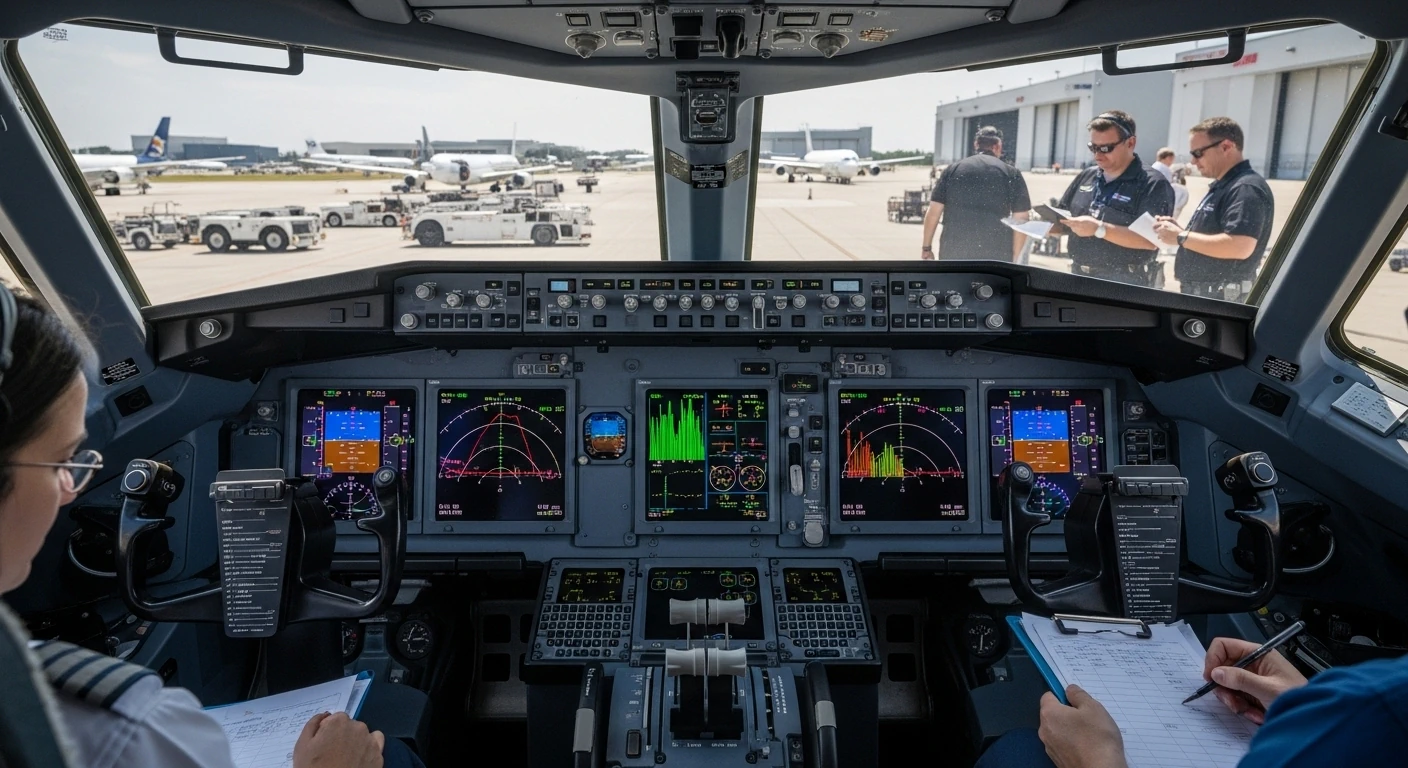

Boeing has introduced a new flight-test display system, VERA (Visually Enriched Rendering Application), designed to improve the accuracy and efficiency of 777-9 test maneuvers by integrating real-time test parameters onto standard primary flight displays (PFDs). Aviation Week’s Guy Norris reported that Boeing expects the system to raise first-time test success rates substantially, from a historical ~70% toward an expected 85% for the first release and with a longer-term target approaching 98%.
The VERA initiative aims to cut program time and costs by reducing repeated test runs while maintaining rigorous safety margins. The display is already deployed on 777-9 flight test aircraft and is being trialed on other Boeing test fleets, including the 737-10. Boeing’s test pilots and engineers collaborated on the design to ensure pilots receive intuitive visual cues on existing PFDs rather than relying solely on auxiliary engineering displays.
What is VERA and how does it change flight testing?
VERA, short for Visually Enriched Rendering Application: projects flight-test targets, constraints and live parameters directly onto the aircraft’s standard PFD. The graphics, colors and icons are tailored to pilot familiarity and provide immediate feedback during complex maneuvers. This differs from traditional auxiliary engineering displays and aims to reduce cognitive switching and improve precision.
Key points:
- VERA uses existing PFD hardware to show test parameters in pilot-familiar symbology.
- Boeing’s internal data showed a historical ~70% first-time success rate for civil program maneuvers; VERA is intended to increase that to ~85% initially. The long-term objective is parity with defense program success rates closer to 98%.
Why it matters for the 777-9 program
Flight-test efficiency directly affects certification timing and program costs. The 777-9 is a flagship widebody whose certification and entry into service remain strategically important for Boeing’s recovery. Reducing repeated test runs helps expedite certification milestones and can improve predictability for launch-customer deliveries. Aviation Week places VERA within broader 777-9 efforts, which include adding new test aircraft and stepping through noise, structural and systems tests.
How Boeing developed VERA
Boeing adapted lessons from its defense test programs, where improved flight-test aids achieved success rates near 98%, and built a PFD-based visual system suited to commercial pilots. Engineers emphasized continuity with Boeing’s flight-deck philosophy: familiar alerts, consistent color schemes and envelope-limiting cues to avoid confusing pilots used to standard avionics presentations. The system underwent pilot skepticism initially but was refined through cockpit feedback and lab testing.
Industry context: certification, safety and schedules
- Certification: The 777-9 program has faced schedule pressures and a series of regulatory and engineering milestones. Tools that raise first-time test success can reduce schedule risk, but they do not replace the extensive validation, paperwork and independent verification required by regulators such as the FAA and EASA.
- Safety posture: Boeing emphasizes that VERA supplements standard procedures and is used within rigorous test safety frameworks; envelope protections and fallback systems remain part of the flight-test architecture.
Timeline & recent related developments
- Aug 2025: Boeing continued adding 777-9 test aircraft to the program, expanding hours and test scope.
- Sept 2025: Aviation Week reported VERA’s deployment on 777-9 (and trial use on 737-10) with program goals to improve first-time success rates.
What analysts say
Independent analysts view VERA as a pragmatic engineering tool: a modest but meaningful productivity improvement for flight testing. While it can reduce repetitive maneuvers and accelerate data capture, certification still relies on exhaustive validation and regulator assessments, so VERA is necessary but not sufficient to speed final approvals. Aviation Week frames the system as part of a suite of steps Boeing is taking to manage program risk.
What’s Next / Industry Outlook
- Broader rollout: Boeing is expected to refine VERA based on ongoing tests and may deploy variants across other flight programs (e.g., 737-10, future 777-8F test aircraft).
- Regulatory watch: Regulators will evaluate the role of real-time PFD overlays in flight testing and any implications for certification evidence and pilot workload. Implementation will require documented safety cases.
- Program impact: If VERA consistently raises first-time success rates toward Boeing’s targets, it could lower test hours and costs and modestly improve certification schedule predictability, but it will not eliminate core certification hurdles.
Sources & Attribution (key load-bearing citations)
- Aviation Week, Guy Norris, “Boeing Improves 777-9 Flight-Test Execution With New Pilot Display.”
- Boeing feature — “5 in flight: See the full 777-9 fleet in action” (Boeing media/feature).
- AirGuide / trade coverage summarizing VERA deployment and targets.
- Aviation Week reporting on 777-9 program updates and noise certification testing.
- Aviation Week: “Fifth 777-9 Joins Boeing Certification Test Program” (program expansion context).