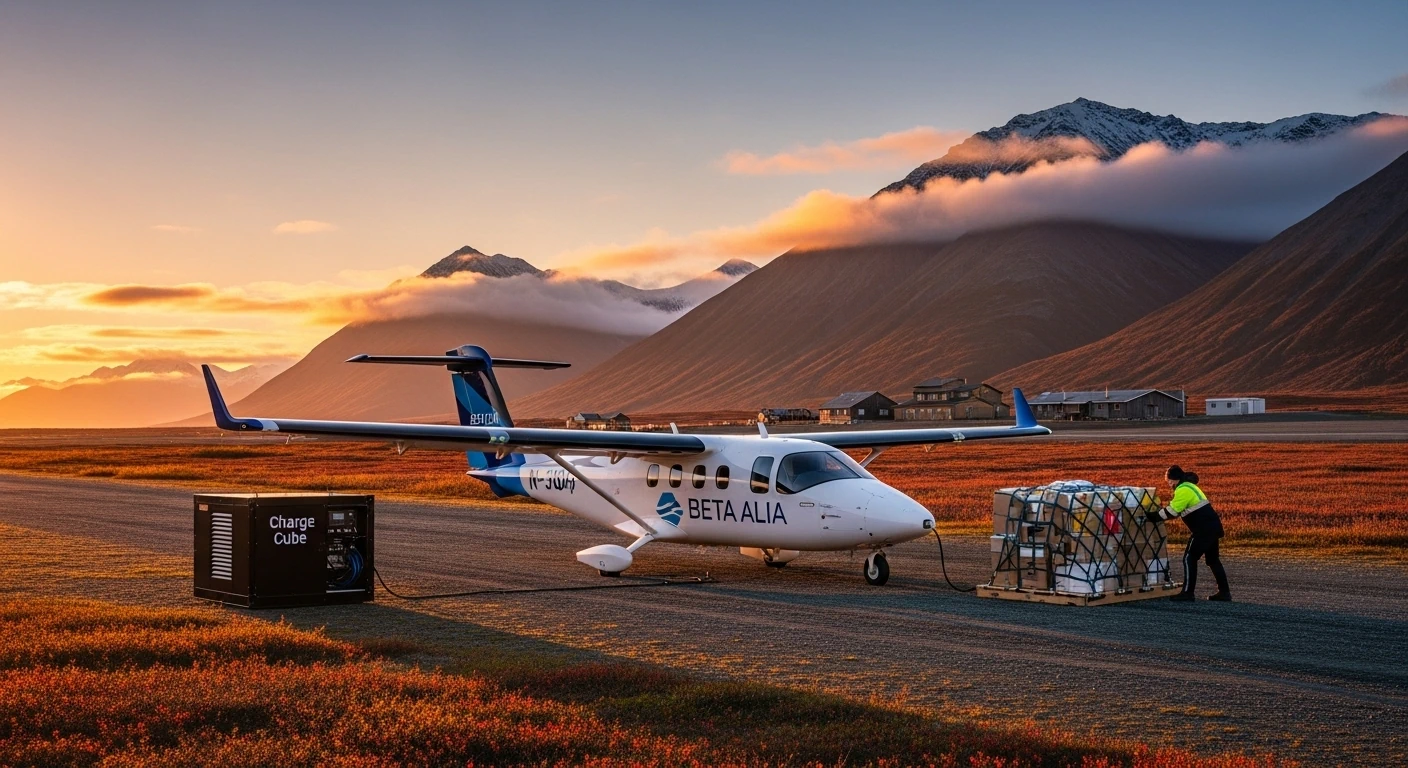

Alaska bush carrier Ryan Air has placed a deposit-backed order for BETA Technologies’ ALIA (also marketed as the CX300/ALIA) electric short-takeoff and landing aircraft and will deploy up to 10 BETA Charge Cubes to support operations across its Alaskan network, the companies announced in a press release reproduced by Vertical Magazine. The aircraft and charging infrastructure are intended to expand Ryan Air’s cargo throughput and reduce emissions serving remote communities.
BETA and independent aviation outlets say the ALIA is designed to carry up to 1,250 lb (≈567 kg) of cargo or five passengers, operate IFR (Instrument Flight Rules) and in known icing (FIKI) conditions, and, when paired with Charge Cubes, enable distributed electric operations even in grid-constrained areas. The agreement is deposit-backed and did not disclose the exact number of aircraft.
Why Alaska is a Strategic Use Case
Alaska’s geography makes aviation essential: many communities lack road access and rely on air links for food, medical supplies and mail. Ryan Air operates from eight hubs and serves more than 70 Western Alaskan communities, a market where short-haul cargo economics and environmental sensitivity make electric propulsion attractive. The carrier’s leadership framed the deal as continuity with its history as an essential lifeline for remote villages.
What BETA’s ALIA (CX300) and Charge Cubes Offer
- Payload & capacity: ALIA/CX300 can move up to 1,250 lb of cargo or five passengers, matching many bush-cargo mission profiles.
- All-weather capability: BETA states the aircraft will be IFR and FIKI capable, enabling operations in challenging Alaskan weather (company claims; regulatory validation pending).
- Charging infrastructure: Charge Cubes are modular charging/energy storage units BETA sells to support aircraft charging and grid stabilization; Ryan Air intends to deploy up to 10 across its network. BETA promotes second-life battery use and community energy benefits in the PR.
Independent trade articles confirm the same program details and report the agreement as deposit-backed and part of BETA’s expanding customer base (which includes prior commitments from Air New Zealand and UPS among others).
Independent Reporting & Industry Context
Major aviation trade outlets, Aviation Week, AINonline, Flying and Electrive; carried stories echoing BETA’s announcement, noting the deposit-backed nature of the order and the planned Charge Cube installations. Those outlets confirmed the story’s essentials while noting the company PR as the original source.
The ALIA program sits amid a wave of electrified short-haul aircraft development aimed at reducing emissions on short regional missions. Operators such as Air New Zealand have previously taken demonstrator ALIA aircraft for familiarization, and logistics players such as UPS (via UPS Flight Forward) have tested electric/alternative platforms, signalling industry interest in electric aircraft for cargo and regional roles.
Caveats & What Needs Independent Verification
- Order size unspecified: The press release and follow-ups do not disclose the number of airframes ordered, only that the agreement is deposit-backed. Independent outlets repeated that the precise quantity was undisclosed. That should be treated as an open detail until BETA or Ryan Air publicly lists the firm order quantity.
- Certification & operational approval: BETA claims IFR and FIKI capability; those capabilities must be demonstrated and approved under FAA/Type Certificate / Supplemental Type Certificate processes or equivalent. Full operational authorization for commercial passenger/cargo flights will require regulatory sign-off.
- Infrastructure & grid claims: BETA’s statements about second-life battery benefits, grid stabilization and community electrification are plausible and interesting, but they are promotional and need independent energy-systems assessment and local utility coordination.
Timeline & Immediate Impacts
- Sept 2025: Deposit-backed agreement announced (deposit-backed, not a fully paid firm order) and intention to deploy Charge Cubes.
- 2025–2026: Industry observers expect initial demonstrator operations and Charge Cube installations (subject to FAA approvals and local permitting).
- Mid-term: If aircraft meet performance and certification milestones, ALIA could enter island-style / bush air cargo schedules that favor short, frequent flights with rapid turnaround enabled by fast charging.
What’s Next / Industry Outlook
- Regulatory approvals: Ryan Air and BETA must secure appropriate FAA approvals (e.g., type/experimental certification pathways, operational exemptions or approvals) to operate in commercial cargo service. The timeline depends on certification progress.
- Infrastructure rollout: Deployment of Charge Cubes in remote communities will require local permitting, utility coordination, and possibly microgrid integration to ensure reliable charging.
- Fleet economics: Electric aircraft promise lower energy costs and quieter operations, but battery lifecycle, maintenance and charging logistics will determine cost competitiveness vs. turboprops and piston aircraft. Independent operational trials will be needed to validate claims.
Sources & Further Reading
- BETA Technologies press release (reproduced in Vertical Magazine), “Ryan Air purchases BETA Technologies’ aircraft…”, Sept 25, 2025.
- Aviation Week, “Cargo Carrier Ryan Buys Beta Electric Aircraft For Alaska,” Sept 2025.
- AINonline, “Alaskan Cargo Carrier Orders Beta’s CX300 Electric Aircraft,” Sept 26, 2025.
- Flying magazine, “Alaska’s Ryan Air Bets on Beta Electric Aircraft,” Sept 2025.
- BETA Technologies LinkedIn announcement / company post.