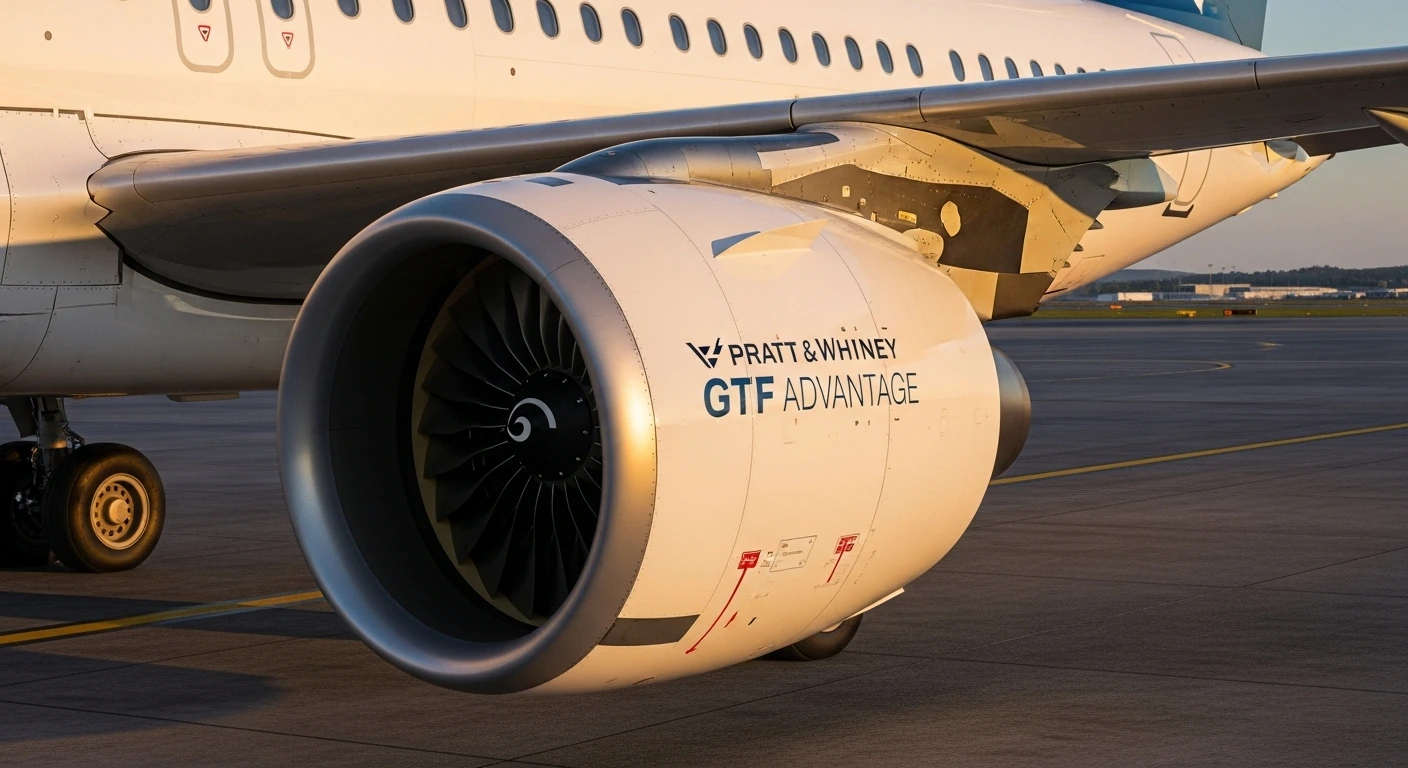

Pratt & Whitney has secured European validation of the GTF Advantage engine’s type certification, clearing the regulatory path for the unit to enter service in 2026, FlightGlobal and Pratt & Whitney announced on 16 October 2025. The European Union Aviation Safety Agency (EASA) validation follows U.S. Federal Aviation Administration certification earlier in 2025 and is a key step for airlines and OEMs planning A320neo-family and other installations.
Pratt & Whitney says the GTF Advantage offers measurable performance improvements over the current geared-turbofan family: roughly 4% more take-off thrust at sea level, 8% more at high-altitude airports, improved fuel efficiency, and a more durable hot-section design promising up to double the time on wing in certain configurations. The manufacturer also intends for the Advantage to become the production standard, with upgrade paths for existing GTF engines.
What the EASA validation means
- Regulatory clearance for Europe: EASA’s validation aligns European acceptance with the FAA’s earlier decision, enabling operators in Europe to place engines on their fleets once airframe installation approvals and airline deployment plans are in place.
- Faster entry into service: Pratt & Whitney said EASA validation paves the way for entry into service in 2026. Airlines that have ordered or are evaluating Advantage-powered aircraft can now finalise operational planning and support contracts.
- Intermixability: The Advantage is designed to be fully intermixable with today’s GTF engines, easing fleet integration and operations across mixed-engine fleets. Pratt & Whitney also offers a Hot Section Plus upgrade that delivers most of the Advantage’s durability benefits to in-service GTFs.
Industry context, why operators care
Airlines and lessors focus on three engine attributes: fuel burn, thrust performance at challenging airports, and maintenance-cost/time on wing. Pratt & Whitney’s GTF family already delivered major fuel-burn reductions versus legacy turbofans; the Advantage iteration targets incremental improvements and greater durability, both attractive in a high-fuel-price, capacity-constrained market.
For carriers operating in hot/high airports or on longer A321XLR-type missions, the additional thrust and payload flexibility (8% boost at altitude) can translate into real network and revenue benefits. The durability claims could lower shop visit frequency and spare-parts burdens if in-service experience confirms test results.
Timeline
- Feb 2025: FAA grants type certification to the Pratt & Whitney GTF Advantage engine.
- 16 Oct 2025: EASA validates type certification, enabling entry into service planning for 2026.
- 2026 (expected): Initial in-service operations and airline deployments begin, subject to airframe installation approvals and operator scheduling.
What’s next? Operator rollout and aftermarket impacts
- Airframe approvals: OEMs (notably Airbus for the A320neo family) must complete aircraft-specific installation approvals and delivery configurations; these interdependencies affect when individual airlines actually receive Advantage-equipped aircraft.
- Aftermarket & MRO: The Advantage’s claimed durability and intermixability will influence MRO planning, spares inventories and shop visit schedules. Pratt & Whitney’s Hot Section Plus program offers a near-term retrofit route for carriers wanting immediate durability gains without full engine replacement.
- Market competition: The Advantage strengthens Pratt & Whitney’s competitive stance against rival narrowbody engine families (CFM LEAP, forthcoming LEAP/LEAP-derived enhancements). Airlines weighing new orders or retrofit investments will test vendor claims against total cost of ownership.
Sources & further reading
- FlightGlobal, David Kaminski-Morrow, Pratt & Whitney secures European validation for GTF Advantage engine, 16 Oct 2025.
- Pratt & Whitney / RTX press release, Type certification for RTX’s Pratt & Whitney GTF Advantage™ engine validated by EASA, 16 Oct 2025.
- AeroTime, MRO Business Today, industry coverage of EASA validation and expected entry into service.