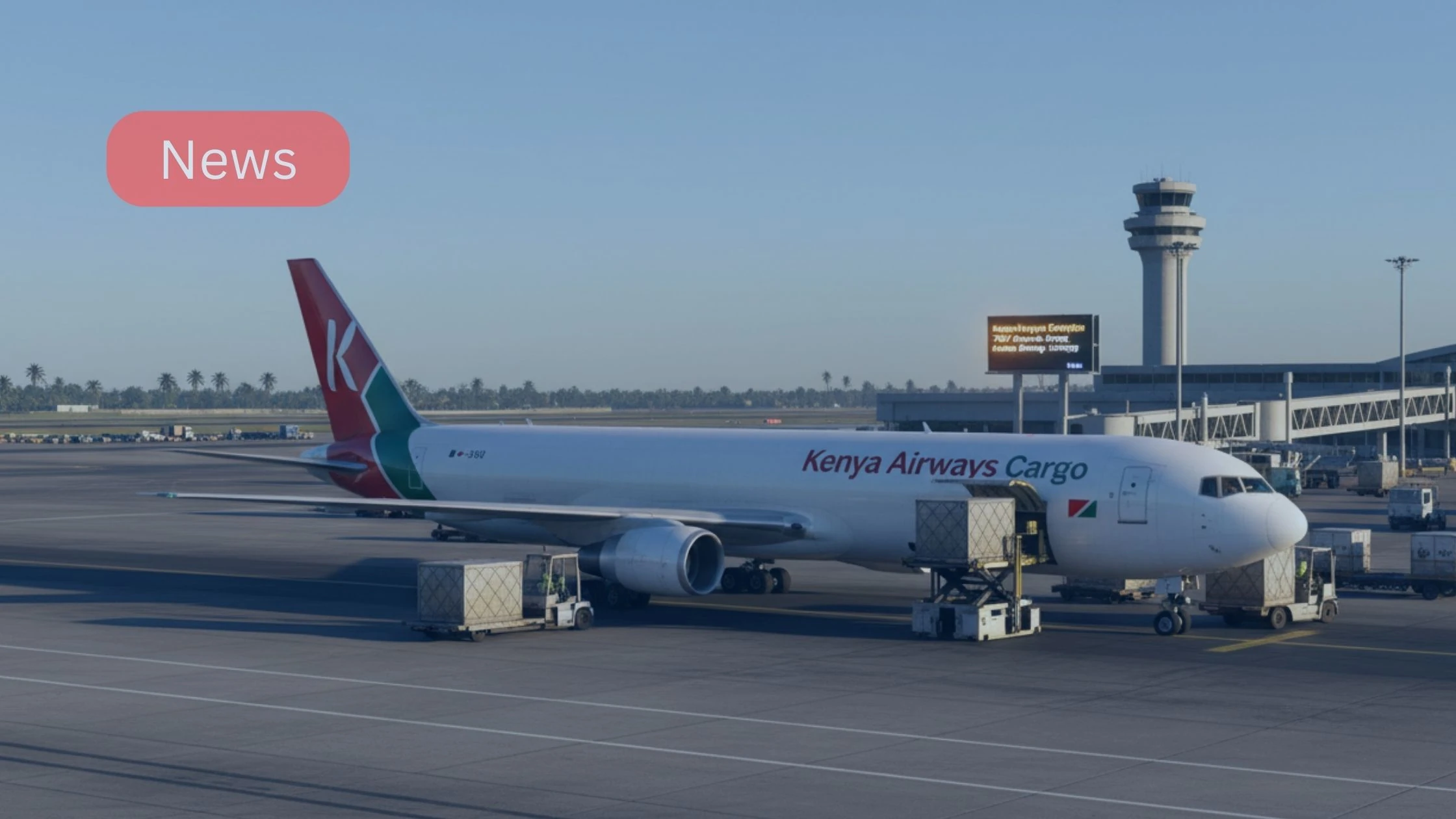

Kenya Airways plans to incorporate Boeing 767 freighters into its fleet in 2026 as a strategic bridge to larger Boeing 777Fs, underlining the carrier’s intensified cargo growth push. This initiative aims to lift the share of cargo revenue from around 10% to 20% of total group revenues in the next 12 months.
According to the airline’s cargo director, Fitsum Abadi Gebrehawaria, the first Boeing 767 freighter is expected to join operations by the end of Q1 2026, with a follow-on aircraft arriving a few months later. These freighters are positioned to serve as a transition fleet, enabling Kenya Airways to build cargo capability and market access ahead of introducing larger Boeing 777F aircraft by the end of the decade.
Strategic Rationale: Why 767s Before 777Fs
Cargo operations have taken on heightened importance in the airline’s recovery and expansion narrative, particularly amid fluctuating passenger demand and structural shifts in global supply chains. Africa’s expanding trade corridors, especially those linking East Africa with the Asia-Pacific and Middle East, present lucrative cargo opportunities.
The Boeing 767 widebody freighter serves as a practical transitional platform:
- Capacity and versatility: The 767 has a cargo payload range that suits medium-haul routes and perishable exports.
- Market readiness: Relatively strong availability of second-hand 767 aircraft allows faster deployment compared with the less available 777F.
- Revenue diversification: Freighters open cargo yield streams separate from passenger operations, a key objective for Kenya Airways.
The airline’s existing dedicated cargo fleet currently comprises four narrowbody freighters, two Boeing 737-300s and two Boeing 737-800s, which focus on intra-continental and regional freight markets.
Cargo Strategy in Detail
Increasing Revenue Contribution
Kenya Airways’ cargo team has publicly stated that the cargo business unit aims to double its revenue contribution from roughly 10% in 2025 to an estimated 20% by end of 2026.
This growth target is driven by:
- Aircraft deployment: Introduction of Boeing 767 freighters followed by Boeing 777Fs.
- Digital investment: Enhanced cargo management systems for capacity planning, real-time tracking, and yield optimisation.
- Network partnerships: Interline agreements and MoUs with global carriers, including Qatar Airways, Air Tanzania, China Southern, Saudia, Turkish Airlines, Ethiopian Airlines, and Bluorbit.
Route Expansion and Market Access
Planned operations with the new widebody freighters will target both Asia-Pacific markets (including Guangzhou and potentially Hong Kong) and Middle East technical stops, particularly for perishables outbound and e-commerce cargo inbound.
This supports broader commercial goals:
- Access to high-yield export markets
- Leveraging perishable export demand from East Africa
- Strengthening cargo connectivity with international freight hubs
Industry Context: Air Cargo Growth
Air cargo globally has experienced varied momentum since the pandemic. While passenger demand recovered at pace, freight volumes saw structural realignment, with an increased focus on supply chain resilience and e-commerce logistics. According to the International Air Transport Association (IATA), global air cargo demand growth is projected at moderate levels as supply chain realignment stabilises.
In Africa, cargo expansion is bolstered by continental trade initiatives such as the African Continental Free Trade Area (AfCFTA), which aims to create a unified market for goods and services across 54 countries.
Boeing 767 vs 777F: Cargo Capability Comparison
While both Boeing types are widebody freighters, they serve distinct strategic purposes.
| Model | Typical Payload | Range | Deployment Role |
| Boeing 767 freighter | ~50–60 tonnes | Medium-haul | Transitional cargo capacity |
| Boeing 777F | ~102 tonnes | Long-haul | Backbone of intercontinental cargo network |
(Source: Manufacturer specifications, industry data)
The 767’s medium-haul profile makes it optimal for markets where full 777F payload capacity is not yet fully commercialised or where aircraft availability is limited.
Risks and Considerations
- Aircraft availability constraints: Larger freighters like the 777F are in high demand, affecting delivery timelines.
- Market volatility: Global freight demand can fluctuate with economic cycles and fuel price volatility.
- Operational costs: Widebody freighters require higher capital and operational investment compared to narrowbody types.
Despite these risks, the strategy appears aligned with Kenya Airways’ dual objectives of revenue diversification and deepened participation in global cargo networks.
What’s Next? Industry Outlook
Near Term (2026)
- Introduction of Boeing 767 freighters by Q1 and mid-2026.
- Expansion of cargo destination coverage, particularly in Asia-Pacific and Middle East markets.
- Continued investment in cargo management technology and enhanced tracking systems.
Medium Term (2026–2030)
- Incremental introduction of Boeing 777Fs to build a long-haul freighter backbone.
- Strengthened partnerships and network interline agreements to amplify cargo reach.
Long Term
- Positioning Kenya Airways Cargo as a competitive African cargo hub, potentially rivaling regional leaders in freight capacity.
Sources
- Kenya Airways’ intention to expand its cargo fleet with Boeing 767 freighters in 2026 is confirmed by Air Cargo News reporting. (Air Cargo News)
- Aim to increase cargo revenue share from ~10% to ~20% of group revenues is supported by secondary reporting in Africa Supply Chain and African Cargo and Bulk Handling. (Africa Supply Chain)
- Longer-term ambition to operate Boeing 777Fs is mentioned consistently across the FlightGlobal article and at least two other aviation news summaries. (Air Cargo News)
- Existing narrowbody freighter fleet makeup (737-300s and 737-800s) aligns with Kenya Airways press releases and industry fleet tracking sites. (Kenya Airways)