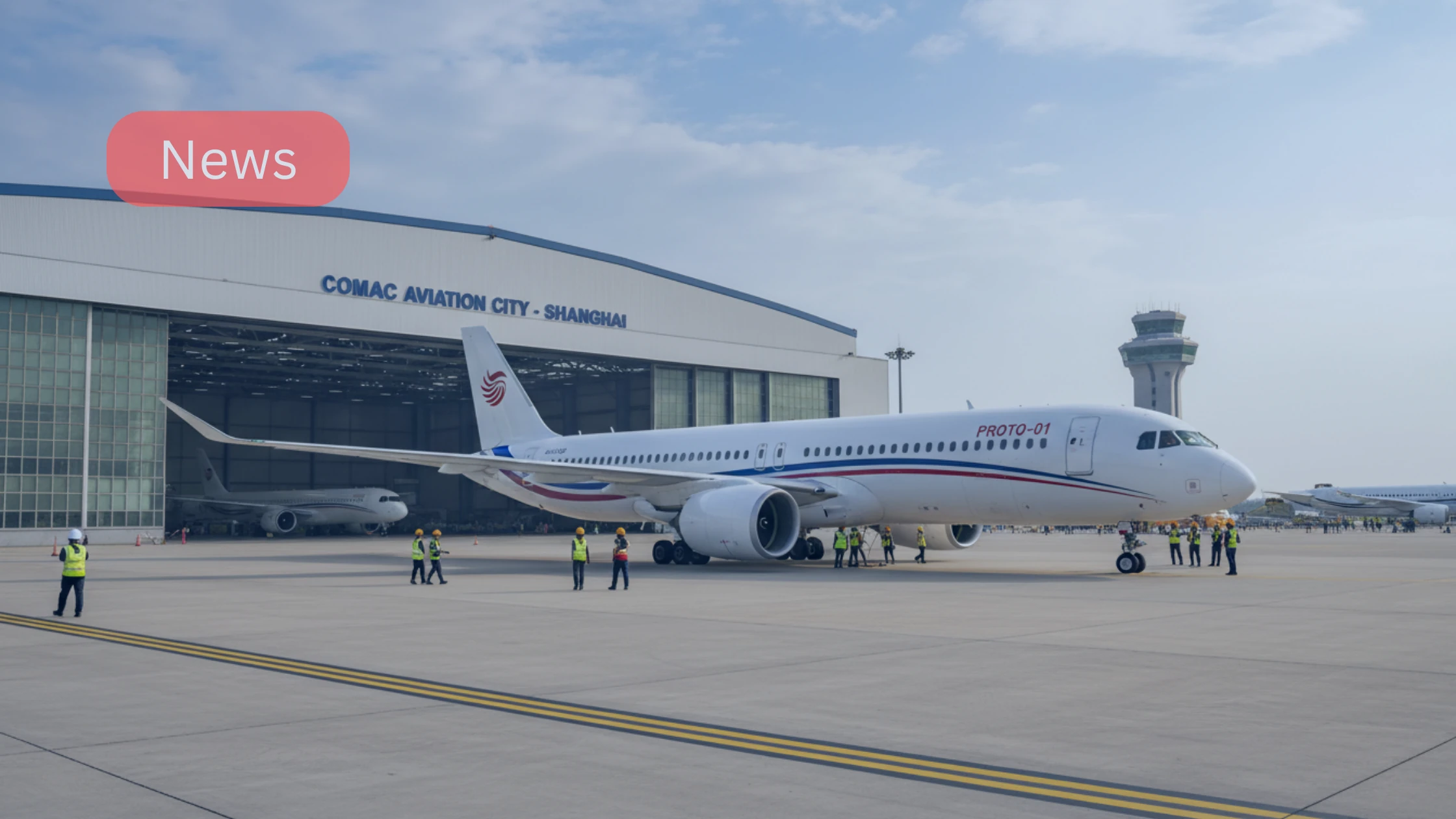

China’s Commercial Aircraft Corporation (COMAC) has taken a visible step forward in developing its COMAC C919-600 high-altitude variant, as the prototype surfaced at the company’s Shanghai facility in advance of planned flight testing. This shortened version of the C919 narrowbody, designed to handle high-elevation operations, was observed during ground preparations, a key milestone as the program moves closer to airborne trials.
Originally outlined in plans unveiled at the 2023 Shanghai International Commercial Airshow, the high-altitude variant, also known as the Plateau variant due to its tailored performance for elevated airports, represents COMAC’s strategy to broaden the C919 family and serve niche markets where thinner air and demanding takeoff conditions challenge standard aircraft.
What Sets the COMAC C919-600 Apart?
The C919-600 differs from the baseline C919-100 model in several structural and operational aspects:
- Shortened fuselage: The fuselage is reduced in length compared with the standard C919, reducing weight and enhancing climb performance in thin-air conditions.
- Optimized for high-altitude airports: Modifications cater to airports situated at elevations commonly found on the Tibetan Plateau and similar geographic regions, airfields where conventional narrowbodies require significant performance margins to operate safely.
- Seating & configuration: Anticipated to seat between 140 and 160 passengers, reflecting its regional and hot/high mission profile.
Aircraft designed for plateau operations must demonstrate robust performance under low-density air, which impacts engine thrust, lift generation, and landing performance. COMAC claims these factors are addressed through specific design adjustments and stronger performance margins in climb and takeoff.
Development Timeline & Flight Testing Path
Program Milestones
- Design revealed: COMAC first teased the high-altitude and stretched variants of the C919 family at the Shanghai Airshow 2023.
- Structural certification: The first prototype’s outer wing box received airworthiness certification from China’s Civil Aviation Administration (CAAC), marking a significant step toward full aircraft assembly and test readiness.
- Prototype sighting: Recent photos show the C919-600 prototype undergoing pre-flight preparations in Shanghai, a strong indicator that ground and taxi tests will soon lead to first flight trials.
- Projected first flight: Based on industry projections and component certification activity, the first flight is now expected around 2027, aligning with the development schedules seen in similar advanced airliner programs.
Flight tests will likely involve hot and high airports such as Lhasa Gonggar, Daocheng Yading, and other plateau fields, environments that stress aircraft performance and altitude-related systems.
Who Will Use the C919-600 High-Altitude Variant?
Launch Customer: Tibet Airlines
Tibet Airlines has been identified as the launch customer for the C919-600 high-altitude variant, with an order reportedly including 40 aircraft tailored for plateau operations.
At the Singapore Airshow 2024, COMAC and Tibet Airlines formalized a high-altitude variant agreement as part of a broader cooperation framework for aircraft adapted to China’s elevated regional airports.
Tibet Airlines operates predominantly in western China’s elevated terrain, making a purpose-built C919 variant, capable of managing thin-air climb performance and constrained runway environments, a strategic complement to its route network.
Industry Context & Competitive Positioning
COMAC & Global Narrowbody Aviation
The broader narrowbody aviation news landscape is dominated by Airbus and Boeing families such as the A320neo and 737 MAX. COMAC’s C919 program represents China’s effort to field a domestic alternative, and the addition of a high-altitude variant aims to capture regional and specialized markets where conventional jets face performance limits.
The C919-600’s emergence contributes to a growing portfolio strategy that includes:
- C919-100: The baseline, standard-capacity narrowbody already in service.
- C919-800: A stretched future variant expected to accommodate more passengers.
- Plateau variant (C919-600): Tailored for hot and high airports with specific performance requirements.
Technical & Operational Significance
Aircraft operating at significantly elevated airports face thin-air performance constraints, reduced lift and engine thrust, which complicate takeoff, landing, and climb metrics. A design that mitigates these challenges could provide operational advantages on short and high runways common to plateau regions.
While official performance specifications remain limited, industry reporting suggests the variant will strike a balance between payload, range, and altitude performance tailored to regional demand.
What’s Next for the C919-600 High-Altitude Variant?
The next critical phase for the COMAC C919-600 high-altitude variant includes:
- Ground and taxi testing: Verification of systems before flight.
- First flight milestones: Expected around 2027.
- Certification process: CAAC and potentially international alignment for export.
- Entry into commercial service: Anticipated around 2028 with Tibet Airlines or other operators.
Sources
- Air Data News: COMAC C919-600 High-Altitude Variant Spotted Ahead of Flight Tests
- FlightGlobal: COMAC Teases Two New C919 Variants
(Confirms COMAC’s official plan for shortened and high-altitude C919 variants.) - AeroTime: Tibet Airlines Orders COMAC C919
(Identifies Tibet Airlines as the launch customer and explains plateau operational needs.)