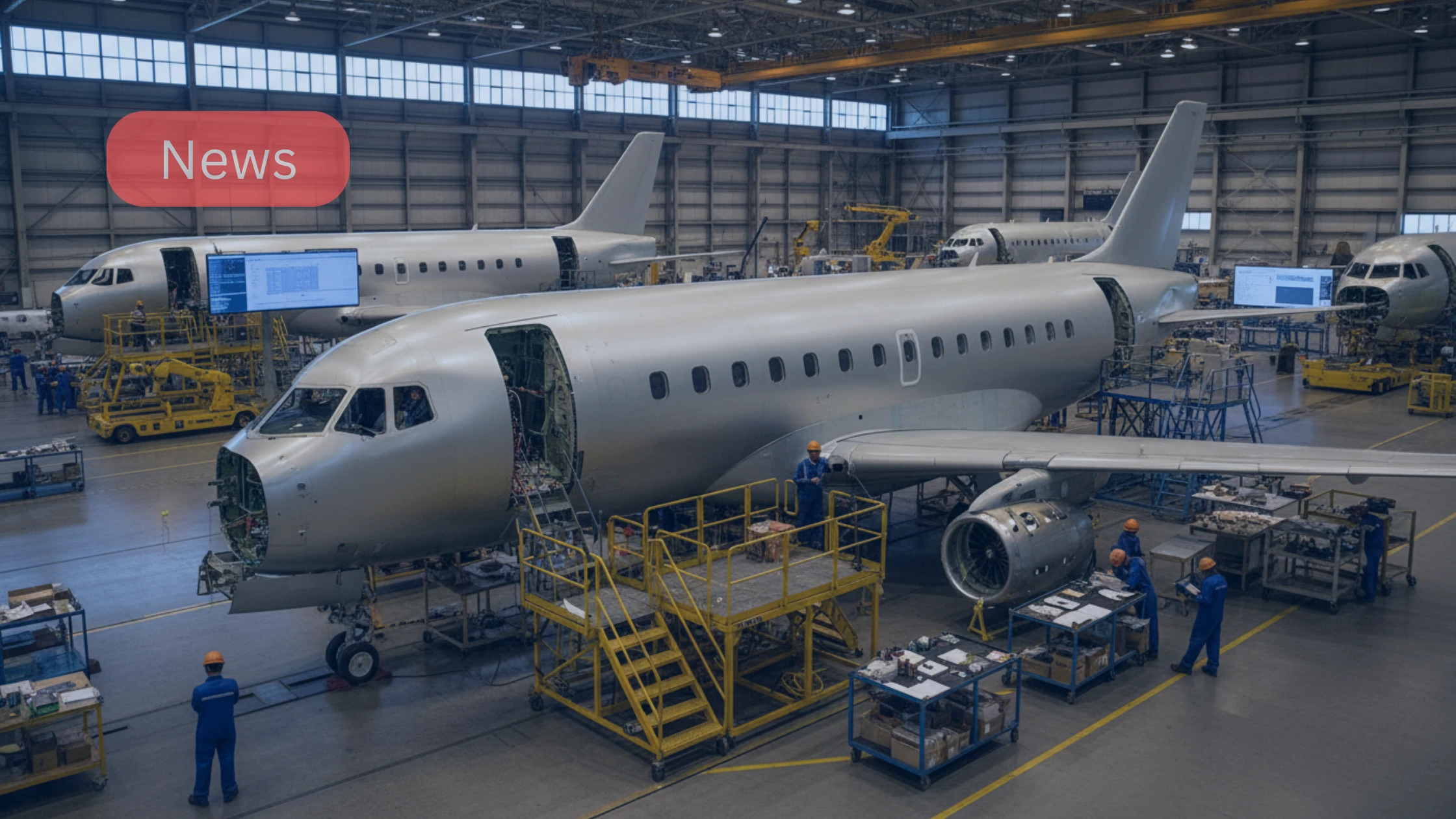

In a landmark development for the Indian aerospace sector, Reuters reports that the Adani Group and Brazil’s Embraer have signed a memorandum of understanding (MoU) to establish an aviation manufacturing collaboration poised to build and assemble regional civil aircraft within India. The pact, announced in New Delhi at India’s civil aviation ministry, marks a significant milestone in efforts to localize aircraft production and deepen strategic industrial ties between the two countries.
This Adani Embraer aircraft assembly India initiative focuses on creating a final assembly line for Embraer’s regional jets, integrating manufacturing infrastructure, and catalyzing supply chain development. The partnership aligns with India’s Make in India policies and addresses projected domestic demand for regional jets over the next two decades.
What the Adani-Embraer Pact Covers
Who
- Adani Defence & Aerospace, the aerospace arm of the Indian conglomerate Adani Group.
- Embraer S.A., Brazil’s leading aircraft manufacturer and the world’s third-largest aircraft maker behind Airbus and Boeing.
What
- Establishment of a regional civil aircraft assembly line in India.
- Development of an integrated regional transport aircraft ecosystem, including components manufacturing, supply chain, maintenance, and pilot training.
Where
- New Delhi, India, agreement signed at the Ministry of Civil Aviation.
- Assembly and manufacturing facilities are anticipated in industrial zones yet to be finalized.
When
- The partnership announcement occurred late January 2026, with formal planning and implementation expected over the next several years.
Why
- To increase domestic production capacity for regional jets.
- To respond to growing civil aviation demand in India.
- To reduce reliance on imported aircraft parts and finished planes.
How
- Through a Memorandum of Understanding, integrating expertise from both companies and aligning with federal aviation and economic policies.
Industry Context: Aviation Manufacturing and India’s Growth
India’s Aviation Market Surge
India is one of the world’s fastest-expanding aviation markets. Passenger traffic has grown substantially post-pandemic, and the country is projected to become the third-largest global aviation market, behind the United States and China, in the coming decade. (IATA data corroborates this growth trajectory.)
Regional Jet Demand
Embraer estimates that India will need upwards of 500 regional jets (80–146 seats) over the next 20 years as connectivity expands across tier-2 and tier-3 cities.
Aviation Policy Framework
The move supports key Indian government initiatives:
- Make in India: Encourages foreign manufacturers to establish production units domestically.
- UDAN (Ude Desh ka Aam Naagrik): Promotes regional connectivity.
- Aatmanirbhar Bharat: Focuses on self-reliance in high-tech sectors, including aerospace manufacturing.
Significance for the Global Aerospace Supply Chain
Expanded Manufacturing Footprint
Until now, Embraer’s commercial aircraft assembly lines have been concentrated in Brazil. The India pact signals a shift toward geographically diversified production, potentially lowering logistics costs and boosting regional supply resilience.
Jobs and Skill Development
Local assembly and manufacturing facilities will require trained personnel in engineering, production, maintenance, and logistics, enabling job creation and skill development in India’s aerospace sector.
Aftermarket Services and MRO
Beyond assembly, the pact covers aftermarket services and maintenance, repair, and overhaul (MRO) operations, underscoring a full lifecycle approach to aircraft support.
Expert and Official Statements
Jeet Adani, Director of Adani Defence & Aerospace:
“Regional aviation is the backbone of economic expansion… Our vision is to create a complete civil-aviation ecosystem, from manufacturing through training and aftermarket support.”
Arjan Meijer, President & CEO, Embraer Commercial Aviation:
“India is a pivotal market for Embraer, and this partnership combines our aerospace expertise with Adani’s strong industrial capabilities.”
These statements reflect both strategic intent and commercial rationale behind the pact, going beyond simple assembly to broader ecosystem development.
Potential Challenges and Considerations
- Investment transparency: Financial commitments and detailed timelines are yet to be disclosed by either party, making precise forecasts difficult.
- Technical transfer: Realization of full manufacturing (beyond assembly) depends on detailed technology transfer agreements and long-term strategic collaboration.
- Regulatory compliance: Any manufacturing facility must meet ICAO safety standards and obtain approvals from India’s Directorate General of Civil Aviation (DGCA) before operations. (ICAO and DGCA frameworks govern certification requirements for aircraft production.)
What’s Next: Industry Outlook
Short-Term (Next 1–2 Years)
- Facility site selection and infrastructure planning.
- Regulatory assessments and certification pathway design.
Medium-Term (3–5 Years)
- Establishment of a final assembly line.
- Initiation of supply chain localization for critical components.
Long-Term (5–10 Years)
- Expansion into full aircraft manufacturing.
- Integration with global Embraer supply chains and export potential.
This partnership could redefine India’s role in global aerospace, making it a strategic hub for regional jet production and a key participant in international aviation supply networks.
Sources & References
- Reuters– Adani, Embraer announce pact to assemble civil aircraft in India
Aditya Kalra, Abhijith Ganapavaram, Dhwani Pandya (Jan 23 & Jan 27, 2026) - Adani Group (Official Release) – Adani Defence & Aerospace and Embraer announce strategic partnership
- Embraer S.A. (Corporate Newsroom)– India market and regional aircraft strategy
- The Week (India)– Adani Group, Embraer to set up regional aircraft manufacturing facility in India
- IATA – International Air Transport Association– India aviation market growth and passenger demand data
- ICAO – International Civil Aviation Organization – Aircraft manufacturing, safety, and certification standards