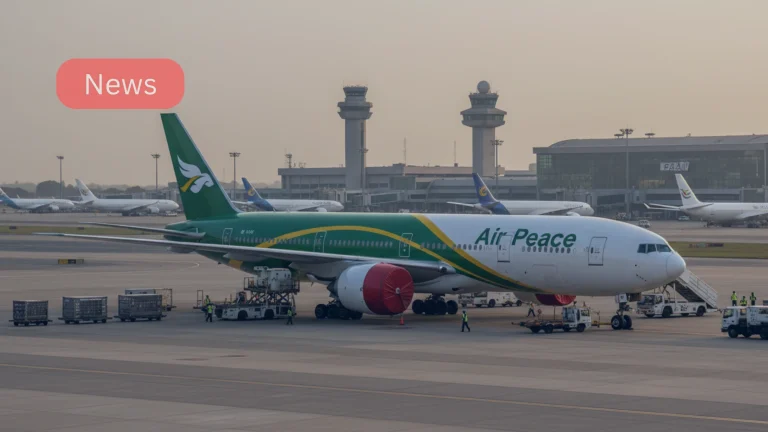

The African Development Bank (AfDB) has earmarked up to $500 million, pending board approval, to help finance a new international airport in Ethiopia that the government says will become Africa’s largest when completed by 2029, according to a Reuters report. The planned four‑runway complex, located near Bishoftu, about 45 kilometers southeast of the capital would ultimately be capable of handling around 100 million passengers annually, a step‑change that aims to cement Ethiopia’s role as a pan‑African aviation hub.
The bank’s proposed facility serves as an anchor in a broader $10 billion funding plan. Ethiopian Airlines, the state‑owned flag carrier, has signed the design agreement for the project and pledged to provide 20% of total financing, with the remainder expected from a mix of creditors led by AfDB, which said last week it is coordinating roughly $7.8 billion in additional capital.
From capacity pinch to mega‑hub
Ethiopia’s existing gateway, Addis Ababa Bole International Airport, has undergone expansions in recent years but is approaching its structural and operational limits as Ethiopian Airlines has scaled up its long‑haul network. In August 2024, Reuters reported that Sidara, the Dubai‑based engineering firm, was selected to design the new airport, a milestone that set the clock for a five‑year build culminating in 2029. Project leaders have repeatedly described the scheme as a two‑phase development aimed at delivering capacity in tranches while preserving future expansion options.
Trade and official coverage since then have portrayed a program designed to open with an initial capacity near 60 million passengers per year, with expansion to ~110 million as traffic grows figures that would place the airport among the world’s top hubs. AfDB’s signaling of an anchor loan is the clearest indication yet that external financiers are prepared to put substantial capital behind the government’s ambitions.
What the AfDB move means
For continental infrastructure, AfDB’s involvement is more than financial. Acting as the mandated lead arranger and global coordinator often helps crowd‑in additional lenders by standardizing due diligence, environmental and social safeguards, and transparency requirements. The bank told Reuters it had “earmarked up to $500 million, subject to board approval, to anchor the funding of this transformational regional integration project,” language that both underlines the bank’s commitment and makes clear that final sign‑off is still a step ahead.
Industry watchers say AfDB’s anchor role could lower the perceived risk for co‑financiers, making it easier to assemble the remaining $7.8 billion. Comparable African mega‑projects have blended multilateral loans with export‑credit finance and commercial tranches, sometimes backed by sovereign guarantees. Ethiopia’s authorities have not yet published the full capital stack, and the bank’s board documents, once available; will offer the first detailed look at pricing, tenor, and disbursement schedules.
Ethiopian Airlines’ calculus
For Ethiopian Airlines, Africa’s largest carrier by network reach, the new hub is about maintaining connectivity economics and schedule integrity as flows between Africa–Europe, Africa–Middle East, and Africa–Asia deepen. The airline has grown passenger numbers into the high‑teens of millions per year and has articulated ambitions to pass 20 million in the near term, according to prior statements. A larger, modern hub is crucial to support fleet renewal, cargo integration, and MRO (maintenance, repair, and overhaul) capacity.
The plan’s four‑runway design spreads risk by improving resilience to runway closures and peak‑period congestion. For hub‑and‑spoke carriers, the ability to run tightly banked waves of arrivals and departures, especially on long‑haul widebodies, translates directly into better connectivity and higher aircraft utilization.
Scale and sequencing
While the top‑line target is 100 million passengers/year, sources aligned with the project emphasize phasing. The first stage, often cited near 60 million passengers, would add new terminal complexes, parallel runways, and landside access, with later phases overlaying additional gates, cargo villages, and logistics zones. That kind of sequencing allows operators to match capex with demand, a critical discipline for mega‑hubs whose returns depend on traffic growth and airline commitments.
Risks and caveats
Despite the momentum reflected in Reuters’ reporting, there are meaningful risks:
- Credit approval risk. AfDB’s money is subject to board approval. While anchor loans are common in AfDB’s toolkit, policy, environmental, and macroeconomic criteria must be satisfied.
- Sovereign balance sheet. Ethiopia has been managing debt restructuring to stabilize public finances; adding large external borrowings requires careful alignment with debt sustainability frameworks. Investors and rating analysts will scrutinize whether the airport’s cash flows can support borrowing without undue sovereign backing.
- Delivery risk. Building a greenfield four‑runway hub on an aggressive timeline is complex. Global supply chain tightness, construction inflation, and currency pressures could affect costs and schedules.
- Traffic risk. Hitting 60m → 100m passengers will depend on macro demand, competition from regional hubs, bilateral traffic rights, and the airline’s fleet/route strategy.
Regional context: a continental play
If delivered as envisioned, the Bishoftu hub would leapfrog existing African gateways on runway capacity and terminal throughput, aiming to rival Dubai, Doha, and Istanbul for certain connecting flows. For East Africa, the project anchors a broader logistics corridor strategy linking manufacturing, agri‑export, and e‑commerce to long‑haul belly cargo and dedicated freighters.
AfDB has framed the airport as a regional integration asset, language consistent with its mandate to catalyze cross‑border trade and mobility. The bank’s coordination of co‑financing could also standardize ESG safeguards and community impact plans, reducing political friction that sometimes dogs mega‑projects.
How we got here
The 2024 design mandate reported by Reuters marked the transition from concept to engineering. With that foundation, Ethiopia moved to structure financing, traditionally the longest lead item for projects at this scale. The AfDB’s signal, captured in the Aug. 11, 2025 Reuters story, suggests the financing architecture is starting to take shape, even if the board‑level approvals and legal documentation are still to come.
Next checkpoints to watch
- AfDB board decision. Timelines for board review and any conditions precedent attached to the $500m anchor loan.
- Co‑financiers. Identification of additional multilaterals, export‑credit agencies, or commercial banks participating in the remaining $7.8bn raise.
- Public disclosures. Release of environmental/social impact assessments, resettlement frameworks, and procurement plans, documents that typically precede first disbursements on multilateral‑backed projects.
- Construction schedule. Whether contractors are appointed on EPC (Engineering, Procurement, and Construction) or split‑package bases and how phasing aligns with the 2029 completion target.
Bottom line
The Reuters report outlines a pivotal step for one of Africa’s most ambitious aviation projects. AfDB’s intention to anchor the financing provides credibility and structure to a $10 billion plan whose success will hinge on deft sequencing, concessional capital, and careful risk management. For Ethiopia, the prize is a next‑generation hub that scales with its flag carrier and positions the country for the next era of Africa – world connectivity. For lenders, the challenge is to balance developmental impact with bankable project economics.
Source: Reuters, “African Development Bank to finance $500 million of Ethiopia’s new airport,” Aug. 11, 2025; prior Reuters reporting (Aug. 9, 2024). Supplementary corroboration: FlightGlobal; Xinhua summaries of phasing/capacity.