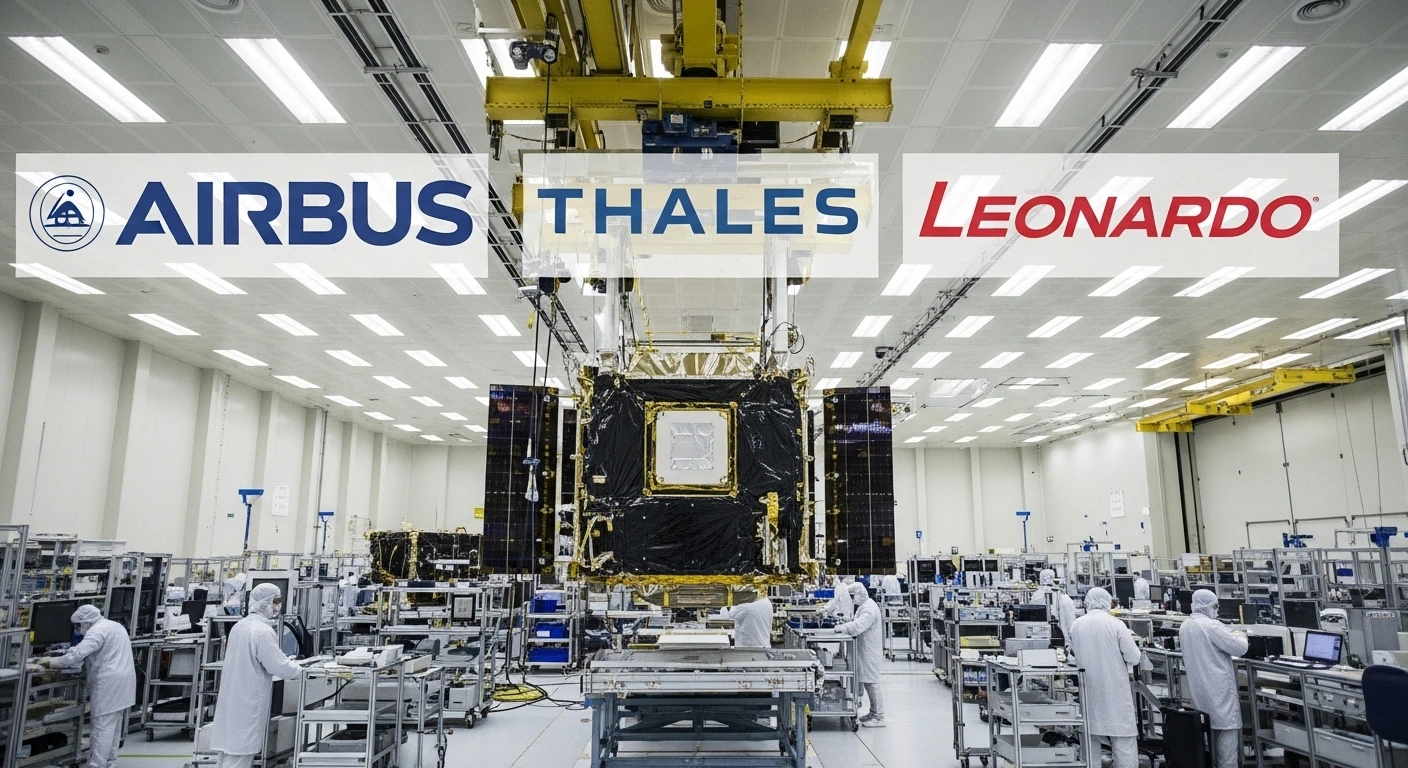

European aerospace giants Airbus, Thales and Leonardo are advancing plans to combine their satellite businesses under an initiative widely known as Project Bromo, and an Airbus executive said the partners could sign a first framework agreement as early as 2025. The disclosure, made by Michael Schoellhorn, CEO of Airbus Defence & Space, underscores growing momentum to create a large European satellite manufacturer capable of competing with U.S. and Chinese players.
Officials describe the effort as a two-step process: an initial framework agreement followed by a closing phase after commercial, regulatory and national security issues are settled. Sources close to the talks have discussed a potential scope in the region of €10 billion and prospective French headquarters, while noting that government approvals and EU antitrust scrutiny remain necessary.
Why the tie-up matters
Project Bromo would consolidate major European satellite manufacturing assets into a single company, aligning engineering, production and supply chain capabilities. Supporters argue the move is intended to secure Europe’s strategic autonomy in space and to compete with rapidly scaling U.S. operators and state-backed Chinese firms that are moving aggressively into low Earth orbit communications. Skeptics warn such consolidation prompts regulatory and national-security sensitivities that require careful safeguards.
At stake are market access and technological scale: a combined entity could pursue large constellation deals, defence contracts and commercial GEO/LEO satellites with greater scale economics than fragmented national champions. However, the deal’s complexity, ownership shares, governance, export controls and national protection for sensitive technologies, means negotiators must reconcile industrial ambitions with political constraints.
What Reuters reported — Schoellhorn’s remarks
In an interview with Italian newspaper Il Corriere della Sera reported by Reuters, Michael Schoellhorn said Airbus, Thales and Leonardo were “on the right track” and that “several issues still need to be clarified,” but he believed a first signature could come in 2025. He described the process as first signing a framework and then working to closing, reflecting standard practice in complex cross-border industrial mergers. Reuters’ coverage places the remarks alongside earlier reporting of a possible €10bn joint venture.
Structure, valuation and national safeguards (what we know)
Reporting from multiple sources indicates planners have discussed:
- A two-step transaction: framework agreement followed by closing.
- A proposed valuation/scope near €10 billion, though precise valuation and asset contributions remain under negotiation.
- A French headquarters as a likely location for the new entity, which raises questions about governance, national protections and the role of France and Italy in vetting sensitive assets.
Those elements remain subject to confirmation in formal filings and national review processes.
Regulatory and political hurdles
The project faces clear regulatory reviews: the European Commission must assess antitrust implications, and national government approvals are necessary given the defence and strategic nature of satellite manufacturing. Reuters’ March reporting noted firms had already entered a pre-notification phase with EU competition authorities, an early step preceding a formal merger filing. That prior engagement shows regulators are aware of the project, but it also signals a potentially lengthy review process.
Political stakeholders in France, Italy and broader EU institutions will closely scrutinize governance arrangements to ensure national security protections and control over sensitive systems (e.g., encrypted military payloads or defence communications) are preserved. That political overlay will shape the final structure and could lengthen the timeline.
Market dynamics and competitors
European consolidation aims to respond to two competitive pressures:
- U.S. commercial scale: U.S. players and prime contractors, including SpaceX’s Starlink ecosystem and major satellite primes, benefit from large domestic markets and financing pipelines. A consolidated European player could better compete for large constellation and government contracts
- Chinese state-backed expansion: Chinese manufacturers and state programmes have expanded production of satellites and launch services, prompting European governments to consider industrial responses. Project Bromo would be intended partly to preserve global market share for European technology.
However, combining companies with different national roots and procurement ties creates friction: defence ministries in multiple countries will demand safeguards that preserve national sovereignty over specific capabilities.
Reactions and next steps
Industry observers welcomed the initiative as a sensible move to create scale but cautioned the deal’s complexity means any timetable is provisional. Experts say the key milestones to watch are (1) a signed framework agreement, (2) formal merger filings and pre-notification responses from the European Commission, and (3) national security clearances in France, Italy and other states party to the company shares. Reuters and other outlets reported that negotiators hoped the framework could be signed in coming weeks, but stressed that closing will take longer.
What’s next — timeline and implications
- Near term (weeks–months): watch for a framework agreement signature and formal pre-notification or filing with the European Commission.
- Medium term (6–18 months): expect intensive regulatory review, political negotiations over governance and national-security carve-outs, and possible adjustments to ownership or national operational protections.
- Long term: if completed, the joint venture could reshape the European satellite supply chain, concentrate manufacturing scale and influence future procurement for defence and commercial constellation projects.