
The structure of an airline’s route network plays a pivotal role in its operational efficiency, customer satisfaction, and overall profitability. Over the decades, airline networks have evolved dramatically due to technological advancements, regulatory shifts, and changing consumer preferences. The U.S. Airline Deregulation Act of 1978 marked a turning point in network design, giving rise to more strategic approaches such as the hub-and-spoke model. Today, airlines primarily utilize three core network types, point-to-point, hub-and-spoke, and grid—each with its own strengths and trade-offs.
Point-to-Point Network (Line Network)
What Is a Point-to-Point Network?
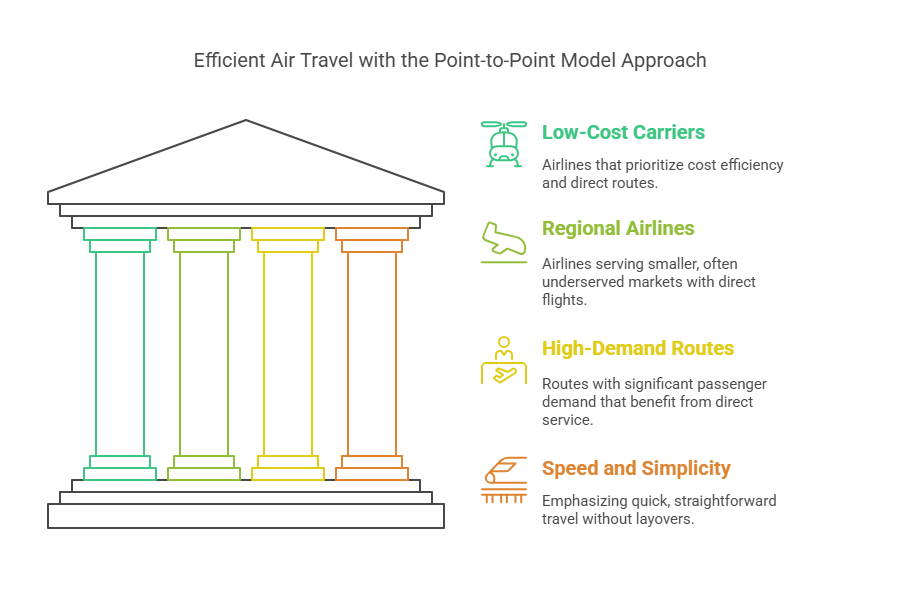
A point-to-point network, often referred to as a line network, is the most straightforward type of airline route system. In this model, airlines offer direct flights between two cities without routing passengers through a central hub. While the term “line” suggests a straight path, the actual layout may resemble geometric patterns like a triangle or circle, depending on the route combinations.

Use Case: This model is frequently used by low-cost carriers (LCCs) and regional airlines. It’s ideal for high-demand, short-haul routes where passengers value speed and simplicity over connection options.
Real-World Example
- Southwest Airlines in the United States is a well-known user of the point-to-point model, allowing customers to fly directly between secondary airports without the need to stop at a central hub.
Advantages
- Increased Efficiency: Faster travel times and minimal layovers.
- Enhanced Flexibility: Easier to adjust routes based on demand.
- Greater Customer Convenience: Direct flights simplify travel.
Disadvantages
- Limited Connectivity: Fewer options for remote destinations.
- Higher Operating Costs: Requires multiple operational bases.
- Lower Load Factors: Less efficient aircraft usage due to fewer connections.
Hub-and-Spoke Network
What Is a Hub-and-Spoke Network?
In the hub-and-spoke model, airlines connect several peripheral cities (spokes) to a central hub airport. Passengers flying from one spoke to another must transfer through the hub. This model mirrors the spokes of a wheel, all radiating from a central point (the hub).

Strategic Value
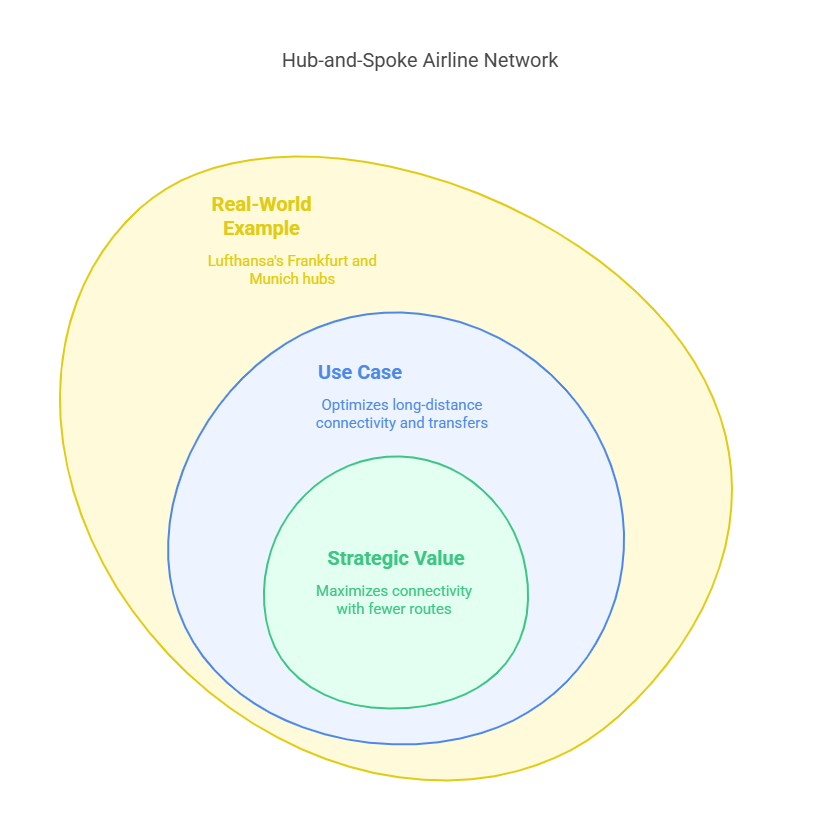
This network type enables maximum connectivity with fewer routes. Instead of operating a direct flight between every city pair, airlines can consolidate traffic and improve load factors, especially on long-haul or international routes.
Use Case: This is the dominant model for legacy carriers and airlines with global networks seeking to optimize long-distance connectivity and transfer opportunities.
Real-World Example
- Lufthansa operates a hub-and-spoke system centered on Frankfurt and Munich. This allows passengers from across Europe to connect to long-haul destinations worldwide through its hubs.
Advantages
- Increased Connectivity: Access to many city pairs via a central hub.
- Economies of Scale: Reduced costs through consolidated operations.
- Better Load Factors: Optimized long-haul aircraft utilization.
Disadvantages
- Longer Travel Times: Layovers increase total journey duration.
- Hub Dependency: Disruptions at the hub impact the entire network.
- Operational Complexity: Requires advanced coordination and systems.
- Limited Direct Routes: Smaller cities may only be served via the hub.
Grid Network (Focus City Model)
What Is a Grid Network?
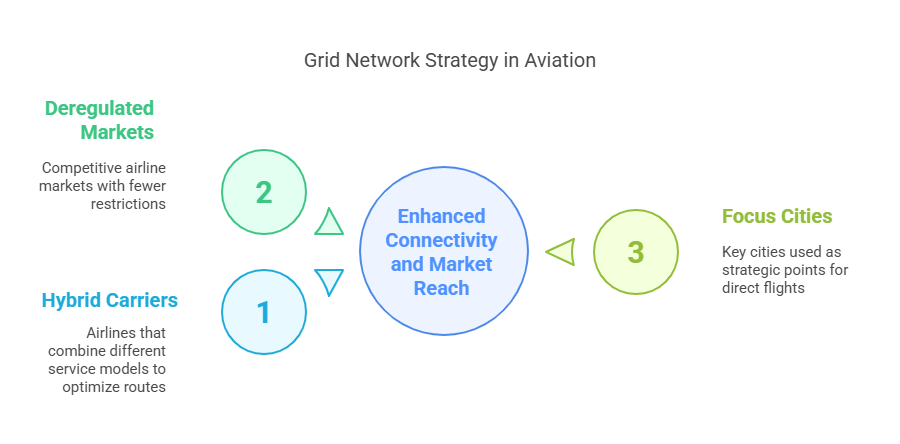
A grid network features multiple direct routes connecting cities without relying on a central hub. While it may appear similar to a hub-and-spoke system visually, the operational logic is different. In a grid network, certain cities act as focus cities—strategic operational centers—but not necessarily as transfer hubs.
Key Features
- Emphasis on point-to-point service without encouraging or designing for connections.
- More autonomous route management, with each flight serving primarily local demand.

Use Case: Grid networks are favored by hybrid carriers and airlines in deregulated, competitive markets that target underserved or niche city pairs.
Real-World Example
- JetBlue uses a grid strategy with multiple focus cities like New York (JFK), Boston (BOS), and Fort Lauderdale (FLL), offering direct connections without heavily promoting passenger transfers through a single hub.
Advantages
- Greater Direct Connectivity: More point-to-point options.
- Route Independence: Each route operates independently.
- Operational Flexibility: Less vulnerable to single-point disruptions.
Disadvantages
- Limited Connection Options: Fewer transfer opportunities.
- Inefficiency for Long-Haul: Harder to consolidate long-haul traffic.
- Lack of Scale Economies: Limited cost advantages.
Hybrid Airline Network Models
Definition: Hybrid networks combine elements from point-to-point, hub-and-spoke, and grid models.
Examples:
- British Airways: Hub-and-spoke via Heathrow; grid via Gatwick.
- U.S. Carriers: Mix of hubs and focus cities for regional flights.
Benefits
- Market Diversification: Tailor operations to business and leisure travelers.
- Operational Resilience: Less reliance on one hub.
- Scalable Growth: Strategic expansion into underserved markets.
Choosing the Right Network Strategy
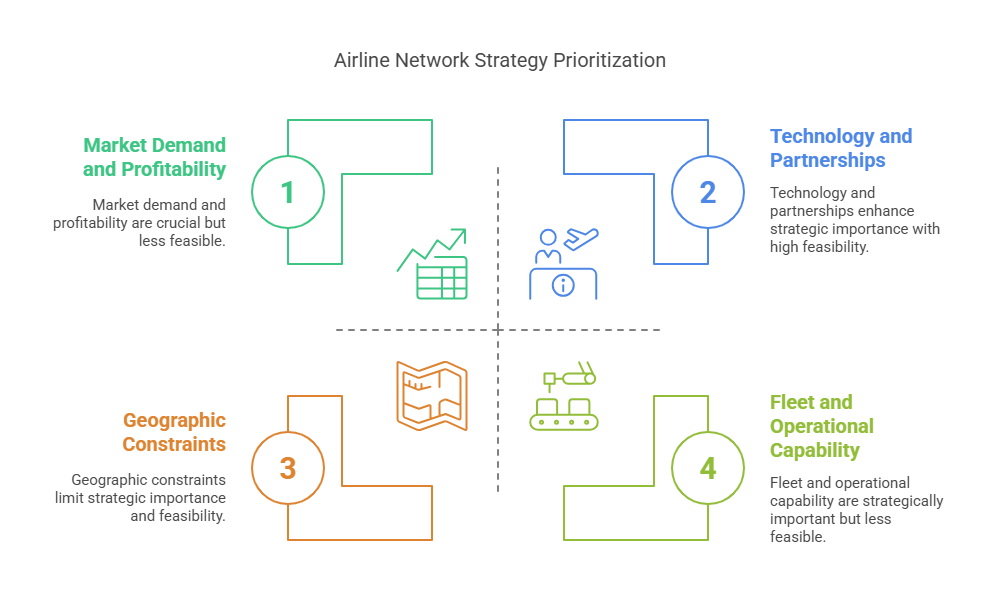
Airlines must consider
- Market demand and route profitability
- Geographic and infrastructure constraints
- Fleet and operational capability
- Technology, partnerships, and virtual interlining
Each network model has unique benefits and challenges. As aviation evolves, flexibility and data-driven strategies will be key. Hybrid models are increasingly shaping the future of airline connectivity.