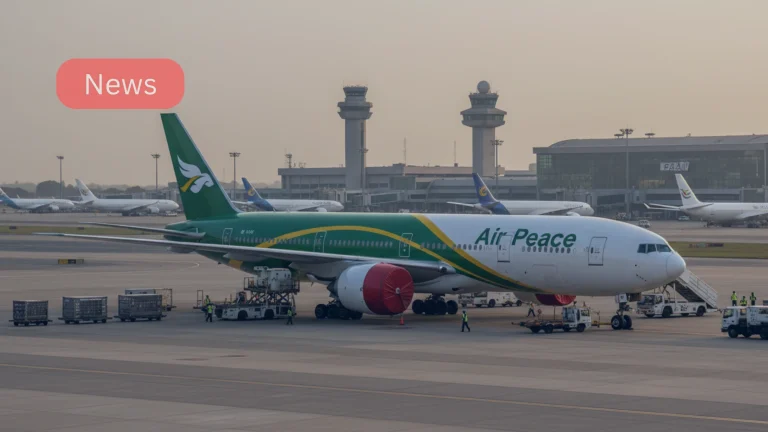
Air Peace chairman Allen Onyema said aviation can lower trade costs, boost tourism and deepen bilateral prosperity during the airline’s induction into the Nigerian-British Chamber of Commerce (NBCC) in Lagos. Onyema’s remarks, delivered at the NBCC members’ evening themed “Trade Without Borders: Aviation as a Catalyst for Bilateral Growth between Nigeria and the UK,” emphasized government support and regulatory reciprocity as central to expanding air connectivity.
Onyema thanked President Bola Tinubu and the Minister of Aviation for backing local carriers during the UK market access push, saying the President’s intervention, including warnings about denial of entry rights, helped secure Air Peace’s access. The induction and Onyema’s speech were covered by several national outlets and posted by NBCC and Air Peace on social channels.
Why Aviation Lowers Trade Costs
Direct air links reduce transit times and handling layers for goods. Faster door-to-door times lower spoilage and inventory costs for perishable and time-sensitive products. Airlines and industry groups argue that better air services, combined with streamlined customs, harmonized rules and predictable landing rights, can materially shrink trade transaction costs. Onyema framed this as a practical lever for Nigeria-UK trade expansion.
Verified facts from the NBCC event
- Event & theme: NBCC Quarterly Members’ Evening & Induction Ceremony, “Trade Without Borders: Aviation as a Catalyst for Bilateral Growth between Nigeria and the UK.”
- Inducted member: Air Peace was formally inducted into the NBCC; NBCC and Air Peace posted about the induction.
- Onyema’s on-record quote: “President Tinubu and the Minister of Aviation did everything possible to support us. The President even warned that if Air Peace was denied entry rights, there would be consequences.” reported by Vanguard and multiple outlets.
Policy context: access, reciprocity and SAATM
- Market access & reciprocity: Bilateral Air Service Agreements (ASAs) govern traffic rights. Onyema’s call for reciprocal entry aligns with longstanding industry calls for fair access and enforcement of negotiated traffic rights. Regulatory reciprocity can mean routes for carriers from both nations and equitable slot allocations.
- Single African Air Transport Market (SAATM): Africa’s SAATM initiative aims to liberalize intra-African air services to reduce costs and improve connectivity; Onyema and NBCC members framed wider liberalization as complementary to Nigeria-UK bilateral steps. SAATM progress is mixed and implementation varies by state.
Economic and commercial implications
- Tourism: Direct flights cut travel friction, which typically raises inbound tourism and shortens business travel time. Onyema highlighted tourism opportunities for both nations.
- Trade: Faster air cargo and better bellyhold capacity support perishable exports (agriculture, seafood) and high-value manufactured goods, potentially boosting bilateral trade volumes if customs and certification bottlenecks are reduced. This is a standard economic logic but requires coordinated customs and SPS (sanitary/phytosanitary) measures to be realized.
Timeline & next steps
- Sept 2025: Air Peace inducted into NBCC; Onyema delivers keynote on aviation and bilateral growth.
- Short term: Expect NBCC and airline follow-ups on business panels, regulatory dialogue with the UK and industry working groups to address cargo facilitation.
- Medium term: If Nigeria and the UK adopt facilitation measures (visa, customs, standards alignment), increased scheduled services and cargo frequency could follow, but this requires bilateral negotiation and regulatory implementation.
What’s Next? Industry Outlook
Onyema’s speech highlights the private sector’s appetite for deeper aviation links with the UK. For the rhetoric to translate into measurable trade gains, stakeholders must align on three fronts: air services access (ASAs), customs & cargo facilitation (paperless procedures, SPS), and visa/business facilitation. If governments and industry move in tandem, aviation can reduce trade frictions, but the Vanguard report is a call to action, not a bookkeeping of realized outcomes.
Sources
- Vanguard, Dickson Omobola, “Aviation can cut trade costs, unlock bilateral prosperity – Onyema,” 26 Sept 2025.
- The Nation, “Onyema hails Tinubu for championing local airlines’ cause,” Sept 2025 (corroborating quotes).
- BusinessDay, “Onyema champions aviation as Africa’s economic lifeline at NBCC induction,” 27 Sept 2025 (additional context).
- TravelNews / AviationMonitor, coverage of Air Peace’s NBCC induction and event theme.
- NBCC social posts / LinkedIn confirming event theme and induction.