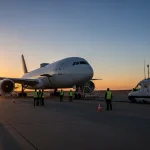
As Gulf carriers continue to shape global aviation, Emirates, Etihad, and Qatar Airways showcase distinct fleet strategies that reflect both ambition and market positioning. A recent Simple Flying analysis highlights these differences through the lens of aircraft types, capacity, and deployment efficiency.
Emirates – Powering with Widebodies
- Fleet Composition: Emirates operates a widebody-only fleet, 116 Airbus A380s (largest in the world) and 133 Boeing 777s, with 8 Airbus A350-900s and growing 777X/787 orders.
- Strategic Focus: The airline’s philosophy centers on capacity superiority and luxury, using the A380 for high-volume trunk routes and the 777/777X for flexibility and cargo generation.
- Market Advantage: Dubai’s geographic hub location enhances the airline’s reach across six continents, reinforcing its role as a passenger and logistical powerhouse.
Etihad – Balanced Fleet, Premium Service
- Fleet Makeup: Etihad operates 102 aircraft, spanning narrow-bodies (A320 family), widebodies (A350, A380, B777, B787), and recent acquisitions of A321neo and A321LR variants.
- Strategic Refit: The airline continues to reintroduce aircraft like the A380 into service while realigning its fleet toward operational efficiency.
- Diversification Strategy: With modern aircraft like the A350-1000 and a mixed fleet, Etihad seeks balance between regional interconnectivity and long-haul routes.
Qatar Airways – Modern & Flexible
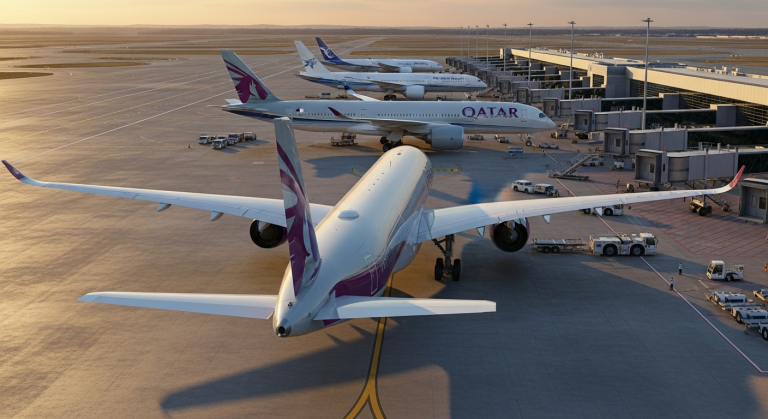
- Fleet Overview: Qatar operates 100+ aircraft, including A320/321 narrow-bodies, A330, A350-900/1000 widebodies, A380s, and remaining B777s and B737 MAX 8s.
- Strategic Pivot: Qatar is phasing out 737 MAX for fleet harmonization and focusing on long-range A350s and existing 777s to reinforce Doha’s strategic hub role.
- Hypercube Hub Model: Doha’s central location, combined with a modern widebody force, fortifies Qatar’s sixth-freedom connectivity dominance.
Strategic Comparisons
| Carrier | Widebody Count | Narrowbody Count | Fleet Focus |
| Emirates | ~249 (A380 + B777) | None currently | Massive capacity, long-haul power |
| Etihad | ~56 (A350/B777/B787/A380) | ~46 (A320 family) | Balanced mix, premium emphasis |
| Qatar | ~80 (A350/B777/B787/A380) | ~40 (A320 family) | Hub efficiency & scalability |
- Market Positioning: Emirates leads on pure capacity, Etihad blends quality with scale, while Qatar emphasizes fleet modernization and agility.
Fleet Trends & Future Moves
- A380 resurgence: Legacy carriers like Emirates and Etihad are reactivating A380s in response to passenger demand recovery.
- Technology Shift: All three airlines have significant A350 and 777X orders, preparing to phase out older widebody models by mid-2030s.
- Narrow-body Strategy: Qatar and Etihad maintain A320 families for regional flexibility, while Emirates continues to depend solely on widebodies, underscoring its global ambition.
What’s Next?
As the industry tightens around sustainability and profitability, each carrier’s fleet choices reflect broader strategy:
- Emirates locks into higher-capacity luxury travel,
- Etihad adapts its mixed fleet for diversified route demand,
- Qatar bets on modernity and operational efficiency from Doha’s hub.
All three airlines are investing in next-gen aircraft like the A350 and 777X, signaling a shared shift toward improved environmental performance and passenger comfort.
Major Fleet Growth: Projecting 2030 Capacities
As of mid-2025, Emirates, Etihad, and Qatar Airways are making aggressive fleet commitments. Here’s how their fleets could grow and shape capacity by 2030 and beyond:
Current Baseline (2025)
- Emirates: 252 aircraft in service; 297 on order (118 A380/A350/777-200LR/777-300ER, plus 205 777X & 35 787-10)
- Etihad: 102 aircraft operating, with orders for A321neo/LR, A350-1000, A380, 777X, 787-10, plus cargo A350F and 777F capacity
- Qatar Airways: 100+ active jets; narrow-body replacements underway (40 A321neo, 10 A321LR), plus 24 A350-1000/34 A350-900 and new widebodies resumed
Projected 2030 Fleet Scenarios
Key Drivers
These are the strategic, economic, and operational factors that shape each airline’s fleet decisions post-2030.
1. Fleet Modernization Goals: Aging aircraft (e.g., A330s, older 777-200LRs) are being phased out due to higher fuel burn, maintenance costs, and emissions.
- Impact: Drives bulk orders of newer-generation aircraft like A350s, 787s, and 777X.
2. Network Strategy Evolution
- Emirates: Continues hub-and-spoke dominance via Dubai, requiring high-capacity long-haul aircraft (777X, A380 replacements).
- Etihad: Moving toward a leaner, profitability-first model, more point-to-point, fewer high-density routes.
- Qatar: Balancing between scale and efficiency, with an increasing focus on Africa and Asia-Pacific connectivity.
3. Environmental & Regulatory Pressure
- Sustainability compliance: ICAO CORSIA rules and EU carbon taxes incentivize airlines to adopt fuel-efficient aircraft (e.g., 787-9, A350-1000).
- Fleet impact: Expect early retirements and slower A380 reactivations unless retrofitted or re-leased.
4. OEM Delivery Pipelines
- Boeing and Airbus backlogs: Delivery slots for 777X, A350, and 787 variants are pushing beyond 2030. Airlines must adapt timelines and fleet mixes.
- Middle East airlines’ leverage: Due to size and financial commitment, Emirates and Qatar often get prioritized.
5. Market Demand Projections
- IATA forecasts strong demand recovery by 2030, especially to/from South Asia, Africa, and East Asia.
- Fleet implication: Greater demand justifies high-capacity aircraft and a balanced mix of long-haul and regional jets.
6. Geopolitical & Economic Dynamics
- Examples: Blockades (like Qatar’s 2017 crisis), oil price swings, and economic diversification in Gulf states influence fleet and hub strategies.
- Risk buffer: Flexible aircraft types (like 787s and A350s) enable quick redeployment if demand shifts or access changes.
Breakdown of the key fleet drivers for each Gulf carrier, aligned with their specific 2030 fleet plans and strategies:
1. Emirates
Fleet Strategy: High-capacity, long-haul hub-and-spoke model centered on Dubai.
Key Drivers
- A380 Phase-Out Begins (post-2030)
- Emirates is the largest A380 operator, but most units will retire by 2035.
- Fleet replacement focuses on 777-9, which offers comparable range with better fuel efficiency.
- 777X Dependency
- 115+ 777X on order (primarily 777-9), forming the future backbone.
- Delays in certification have forced Emirates to extend the life of 777-300ERs temporarily.
- Operational Efficiency Mandates
- The 787-9/787-10 orders help bridge thinner long-haul routes and relieve pressure from fleet over-reliance on big jets.
- DXB Airport Constraints
- Slot limits push Emirates to maintain larger aircraft focus for volume over frequency.
- Global Market Recovery
- Resumed high traffic to South Asia, UK, and Australasia justifies sustained demand for large widebodies.
2. Qatar Airways
Fleet Strategy: Balanced global network with a focus on efficiency, agility, and premium service.
Key Drivers
- A350 Expansion (Key Long-Haul Backbone)
- Over 50 in fleet or on order (mostly A350-1000s).
- Ideal for ultra-long-haul and high-density premium markets (e.g., London, Sydney, New York).
- 787 Fleet Versatility
- 30+ 787-9s offer fleet flexibility across medium- and long-haul routes, helping manage geopolitical disruptions or demand shifts.
- Post-Blockade Rebuild
- Qatar has diversified routes aggressively post-2017 blockade — needing a wider range of aircraft sizes.
- A321neo/XLR Narrowbody Push
- Facilitates Africa and secondary Europe/India routes — a new focus for Qatar by 2030.
- Environmental and Legal Strategy
- Qatar settled its A350 paint dispute with Airbus and resumed deliveries, reinforcing the A350’s central role in its sustainability claims.
Etihad Airways
Fleet Strategy: Shift from scale to profitability, focusing on lean operations and measured growth.
Key Drivers
- Fleet Rationalization Post-Restructure
- Over the past 5 years, Etihad shed dozens of aircraft and deferred/cancelled several orders.
- Now focusing on an optimized mix: 787s for long haul, A350-1000 for flagship routes.
- Focused Growth Model
- Smaller order book (~30 aircraft) by design.
- Selective route expansion with matching aircraft, no fleet excess.
- 787 Dreamliner as Primary Tool
- 39 active and more to come, low trip cost, high efficiency, perfect for flexible deployment.
- Key on US, Europe, and East Asia links.
- Abu Dhabi’s Economic Vision:
- Etihad is positioning itself as the capital’s ambassador rather than trying to match Emirates’ global dominance.
- Leased A350 Integration:
- The A350-1000s allow premium-heavy routes without oversupply, ideal for selective high-yield cities.
| Aircraft Type | Key Drivers |
| A380 | Emirates continues to operate a reduced A380 fleet due to high capacity on trunk routes and slot constraints at key airports like London Heathrow and JFK. |
| 777-300ER | Gradual phase-out expected; still useful for capacity until 777X deliveries ramp up. Some may be converted to freighters. |
| 777X | Major future backbone for Emirates, replacing 777-300ER; offers better fuel efficiency and payload capacity. Also key for Qatar’s long-haul strategy. |
| 787 | High fuel efficiency, suitable for long-thin routes and medium-demand destinations. All three carriers see this as a flexible backbone aircraft. |
| A350 | Flagship for Qatar and Etihad long-haul operations; high efficiency and passenger comfort. Etihad focuses on premium-heavy A350-1000. |
| A321neo/XLR | Critical for Qatar’s regional expansion and thinner long-range routes (XLR model), allowing hub bypass strategies and direct point-to-point routes. |
| A320/A321 (Etihad) | Legacy short-haul fleet; some will remain in operation due to network needs in the Middle East and Indian subcontinent. May be replaced by A321neo variants. |
Fleet Changes & Trajectory

Emirates 2030 Fleet Projection
Based on data from July 2025, Emirates’ fleet status is
- In service: 254 aircraft
- On order: 297 additional units (57 A350-900, 205 777X, 35 787s)
Aircraft Phasing & Deliveries by 2030
- Deliveries before 2030
- A350‑900: ~57 (started late 2024 → 2028)
- 777‑9/‑8 X: ~170 + ~35 (starts 2025 → 2030)
- 787‑8/‑10: ~35 total (20 787‑8 + 15 787‑10)
- Retirements by 2030
- ~40 A380s (older half of current 116)
- ~up to 80 777‑300ERs (phased as 777X entries)
- Small proportion of 777‑200LR (10 units)
These retirements are typical given aircraft age and Emirates’ stated replacement strategy.
Net Fleet Size Estimate for 2030
Combining these figures
- In-service 2025: 254
- + Deliveries up to 2030: +297
- – Retirements by 2030: –120 (approx.)
- Estimated 2030 fleet: ~430 aircraft
Final Estimate
Emirates is likely to operate approximately 430 aircraft by 2030, spanning next-generation widebodies across A350, 777X, and 787 types, compared to ~254 in 2025.
These figures reflect
- Smooth integration of new deliveries
- Phased retirement of older, less efficient jets
Qatar Airways – 2030 Fleet Projection
Current 2025 Stats
- In service: ~227 aircraft
- On order: 40 A321neo + 10 A321LR, 18 A350-1000s. Up to 210 widebodies (130×787 + 30×777X)
Delivery & Retirement Through 2030
- Deliveries
- A321neo / A321LR: 50 total by 2027
- A350‑1000: ~18 by 2028
- 787‑9: 130
- 777X: 30
- Retirements
- 8 A380s
- Remaining A320‑200s and A330-200/300 (~40)
Estimated Fleet Size by 2030
- 2025 Fleet: 227
- + Deliveries: +228
- – Retirements: –48
- Projected 2030 Total: ~407 aircraft
Etihad Airways – 2030 Fleet Projection
Current 2025 Stats
- In service: 102 aircraft
- On order: 24 A350-1000, 15 777-8, 22 777-9, 10 787-9, 20 787-10, 20 A321LR, 10 A350F Freighter
Delivery & Retirement Through 2030
- Deliveries
- A321LR: 20 by 2026
- A350-1000: 24 by 2028
- 777X (8/9): 37 by 2029
- 787 (‑9/‑10): 30 by 2028
- Retirements
- 10 Boeing 777‑300ER
- Up to 3 stored A380s
- Some A320 family (~10) phased out
Estimated Fleet Size by 2030
- 2025 Fleet: 102
- + Deliveries: +111
- – Retirements: –13
- Projected 2030 Total: ~200 aircraft
Summary Table
| Airline | 2025 Fleet | Additions | Retirements | 2030 Forecast |
| Emirates | 254 | +297 | –120 | ~430 |
| Qatar Airways | 227 | +228 | –48 | ~407 |
| Etihad Airways | 102 | +111 | –13 | ~200 |

Capacity & Traffic Impact by 2030
- Emirates: Retiring inefficient A380s and older 777s and replacing them with Airbus A350s and the high-capacity 777X, capacity could increase by 60% or more without increasing flight frequency.
- Qatar Airways: A full shift from the A380 and aging models to A350/A321neo/XLR fleets improves range and fuel-efficiency, supporting an estimated 50–60% system-wide traffic expansion by 2030.
- Etihad Airways: Doubling its fleet and adding new network routes, especially to Southeast Asia and secondary Europe/U.S. markets, could potentially triple passenger volume, heading toward 30–40 million annual travelers by the end of the decade