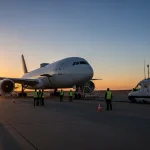
Korean Air has converted seven Airbus A350-1000 orders into A350F freighters, reshaping its future widebody mix as the airline positions for sustained cargo demand and looming CO₂ regulation. The conversion, publicised in industry statements in late October/early November 2025 and reported on 12 November 2025 by Emily Carter at hisgardenmaintenance.co.uk, gives Korean Air seven of the next-generation A350 freighters powered by Rolls-Royce Trent XWB-97 engines.
What the deal means
The move brings Korean Air’s A350 orderbook to roughly 20 A350-1000s, six A350-900s and seven A350Fs, aligning passenger and cargo capabilities while offering commonality benefits for pilots, spares and maintenance. Airbus markets the A350F as a large freighter with ~111-tonne payload and ~4,700 nm range, and manufacturer materials claim up to 40% lower fuel burn/CO₂ vs older-generation freighters (figures originate with Airbus).
Korean Air A350F conversion: technical profile and operational math
Airbus designed the A350F from the outset as a freighter variant with:
- Payload: up to 111 tonnes.
- Range: approximately 4,700 nautical miles (≈8,700 km) at key payload points.
- Structure: >70% advanced composites and lightweight alloys to reduce empty weight relative to legacy freighters, improving fuel economy and decreasing landing/tyre loads.
- Engines: Rolls-Royce Trent XWB-97, the powerplant selected to deliver the thrust and efficiency targets while being compatible with SAF blends.
Why that matters: Lower structural weight + modern engines reduce fuel burn per tonne-km and improve payload efficiency, the economics that make new-build freighters attractive versus converted passenger frames on long-haul lanes.
Timeline & quick facts (Korean Air A350F conversion)
- Late Oct 2025: Airbus announced Korean Air’s conversion of seven A350-1000 orders to A350Fs.
- A350F entry-to-service: Airbus targets entry into service around 2027 (programme timelines and certification processes remain subject to change).
- Payload / Range: ~111 t and ~4,700 nm per Airbus specs.
Regulatory and market context: ICAO 2027 standard & cargo economics
Airbus positions the A350F as the first freighter designed to meet the ICAO CO₂ emissions standard taking effect in 2027. That regulatory clock matters: lessors and operators increasingly value aircraft that can meet or exceed forthcoming emissions benchmarks without expensive retrofits. Independent industry bodies (IATA/ICAO) set standards and monitoring frameworks; Airbus’ claims about compliance are programme statements and will be verified as the type completes certification and in-service audit.
Market impact: Cargo demand patterns since the pandemic have seen structural changes, higher express volumes and demand for scheduled long-haul capacity on high-value lanes. For a large cargo carrier like Korean Air, dedicated modern freighters mean:
- faster turns and main-deck flexibility (large door and optimized pallet loading);
- better fuel efficiency per tonne (manufacturer claims up to ~40% vs old 747Fs);
- resilience to access restrictions tied to emissions or curfew rules at sensitive airports.
Expert reaction & caveats
Trade reporting and Airbus briefings emphasize strong efficiency gains; analysts note three caveats:
- Manufacturer data bias: Performance numbers originate with Airbus and should be validated in service.
- Programme risk: Certification schedules, supply-chain bottlenecks or engine shop capacity could affect entry-into-service timing. The hisgardenmaintenance piece notes programme risk, but offers limited sourcing.
- SAF availability & cost: Gains in lifecycle emissions depend on SAF supply and contracts; aircraft capability alone doesn’t yield full decarbonisation without fuels and operational measures.
Fleet implications for Korean Air and the cargo sector
- Operational commonality: Having passenger and freighter variants in the A350 family reduces training and spares complexity.
- Route strategy: A350F’s range and payload suit Asia-Europe high-density lanes and long transpacific corridors where one-stop economics matter.
- Competitive posture: The move strengthens Korean Air vs operators anchored on 777Fs/older freighters by promising lower operating cost per tonne trip and better emissions performance (per Airbus claims).
What’s Next? Industry outlook
- Certification monitoring: Watch Airbus and EASA/ICAO certification updates and the first A350F entry-into-service metrics (fuel burn, dispatch reliability).
- Lessors & residuals: Lessors will test market appetite for A350F leasing versus existing freighters, this will inform residual values and financing choices.
- SAF contracts: Airlines that secure long-term SAF offtake deals will amplify the A350F’s emissions benefits in lifecycle analyses.
Sources
- Airbus press release and A350F factsheets (Airbus official).
- Trade coverage confirming Korean Air’s conversion: FlightGlobal, SimpleFlying, Aerotime and other aviation outlets.
- Hisgardenmaintenance.co.uk (Emily Carter, 12 Nov 2025), reported the conversion; used here as an initial prompt but cross-checked against Airbus and trade press.