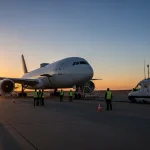
Asia Digital Engineering (ADE), Malaysia’s fast-growing maintenance, repair and overhaul (MRO) specialist, is targeting a major capacity expansion to meet rising regional demand, aiming to double its hangar lines to about 40 within the next three to five years, according to a report by Bernama and corroborated by industry coverage. The plan underscores Malaysia’s bid to strengthen its position as a Southeast Asian MRO hub as airlines keep aging aircraft in service amid delivery delays for new jets.
ADE, a Capital A (AirAsia group)-owned MRO, has seen a surge in business since its founding in 2020, growing revenues and booking out its hangar space through 2025. The company’s growth has been driven in part by a global shortfall in new aircraft deliveries and by airlines’ decision to keep older aircraft flying longer, increasing demand for heavy maintenance and repair works. Reuters reported ADE doubled revenue to 574 million ringgit in 2023 and had booked capacity well into 2025.
Why demand is rising for MRO capacity
Two main factors are fueling the current MRO boom: a slowdown in aircraft deliveries and a resurgent travel market that pushed utilization back up faster than manufacturers could deliver replacements. The result: airlines defer retirements, extend airframe lives, and require more base maintenance checks, structural repairs and component overhauls. ADE’s leadership says the market dynamics justify capacity expansion and investment in new hangars and capability lines.
Regionally, Southeast Asian operators are renewing focus on in-country MRO capability to reduce costs and turnaround times. Singapore today hosts major MRO activity, but Malaysian authorities and private firms, with ADE at the forefront, see an opportunity to capture more third-party work by offering larger hangars, competitive pricing and proximity to low-cost carriers based in the region. Recent articles from SCMP and industry briefs highlight Malaysia’s strategic position and ADE’s ready capacity to scale.
ADE’s concrete plans and timeline
Bernama reports that ADE aims to increase hangar lines to around 40 within three to five years. ADE already operates what it describes as Malaysia’s largest MRO hangar near Kuala Lumpur International Airport, able to accommodate multiple narrowbodies and some widebodies; industry reporting says the facility is heavily booked through mid-2026. ADE plans to add additional lines progressively to meet third-party demand and to support AirAsia’s fleet and other regional customers.
Reuters’ 2024 coverage provides additional context: ADE had doubled revenue to 574 million ringgit in 2023 and had developed new software and marketplace services (predictive maintenance and parts trading) to support higher volumes. Those business lines complement hangar expansion by improving throughput and aftercare services for clients.
Economic and strategic implications for Malaysia
If ADE successfully scales, Malaysia could capture more of the region’s third-party MRO market, a high-value services sector that supports skilled jobs, supply-chain clusters and aerospace ecosystem growth. Observers note the potential economic multiplier: larger MRO operations draw parts suppliers, logistics firms and technical training programmes, strengthening national capabilities over time. Malaysian policymakers have flagged aerospace and MRO development as part of broader industrial strategy.
However, expansion faces headwinds. Scaling hangars requires capital expenditure, skilled labour (licensed engineers and technicians), and robust supply-chain reliability for spares. Competition remains intense: Singapore, Thailand and other regional players also invest in MRO capability, so ADE and Malaysian policymakers must balance speed with quality and regulatory compliance to win trust from international airlines.
Industry reaction and partners
ADE has positioned itself as both an in-house service provider for AirAsia’s fleet and a third-party MRO vendor. Industry sources say ADE is in discussions with potential airline customers across Asia and is exploring partnerships for component support and training pipelines. The company’s previous public statements also flagged ambitions to work with non-Western OEMs, including potential ties to COMAC for certain repair markets, though commercial details remain exploratory. Reuters and trade reporting say ADE is expanding not just in physical lines but also in digital services that streamline parts trading and predictive maintenance.
What could derail the plan?
Key risks include: funding constraints if capital markets tighten; delays in recruiting and certifying sufficient licensed technicians; and slower-than-expected third-party contract wins if airlines instead favor entrenched MRO providers or prioritize in-house capacity. Additionally, global OEM supply issues or changes in airline fleet strategies (e.g., sudden adoption of new aircraft types that require OEM-authorized MRO paths) could affect demand patterns. ADE’s plan is a commercial target rather than a guaranteed deliverable.
What’s next
- Short term (6–12 months): ADE will likely announce specific hangar builds, partner contracts and recruitment initiatives; watch Bernama and company press releases for formal project milestones.
- Medium term (1–3 years): construction of new hangars and ramping of trainee pipelines; monitor booking schedules and third-party contract wins as early indicators of success.
- Long term (3–5 years): if ADE reaches a 40-line footprint and secures international clients, Malaysia’s MRO market share in Southeast Asia could rise materially, but realization depends on execution and competitive response.