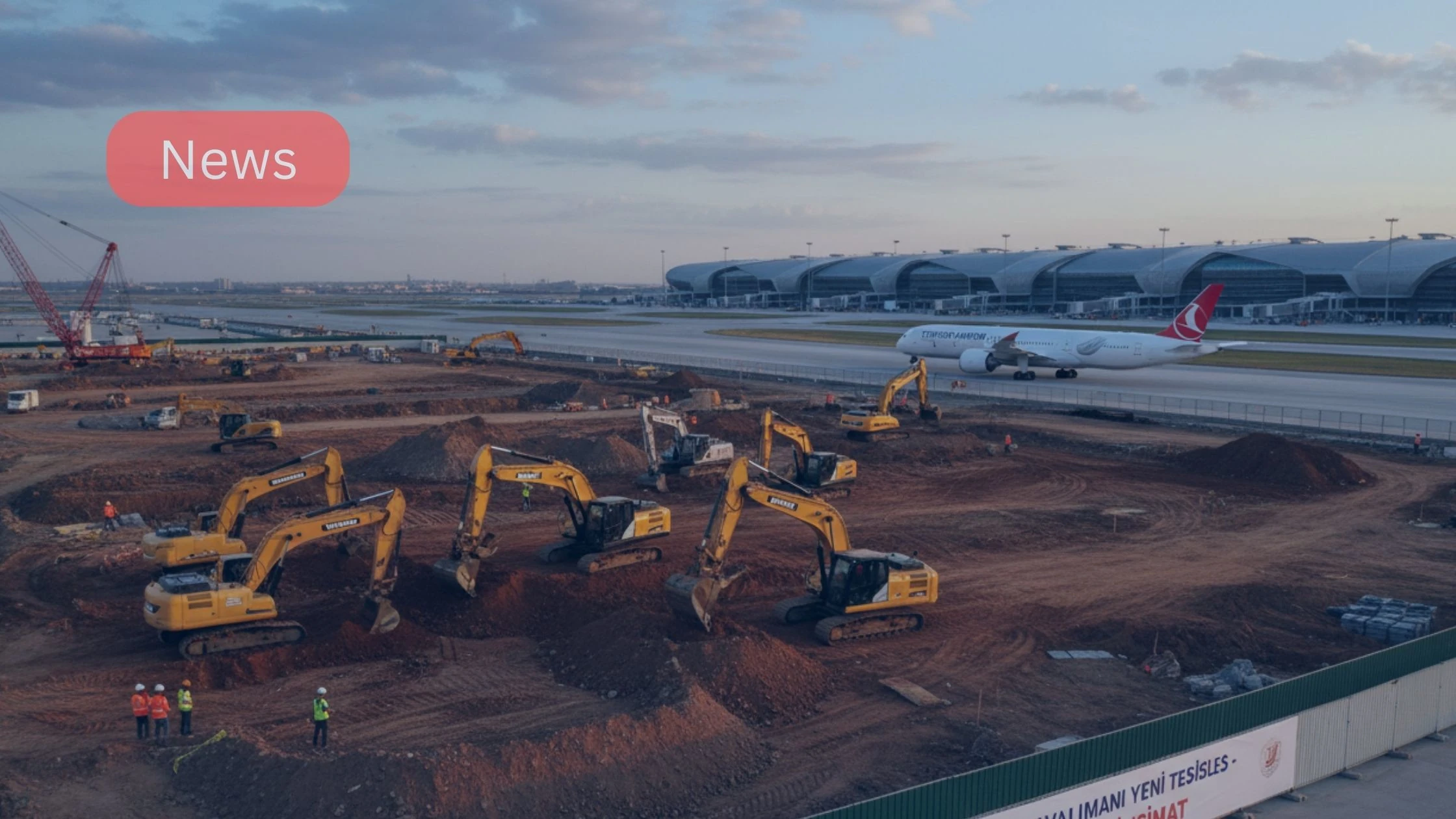

Turkish Airlines has launched a landmark Turkish Airlines investment initiative valued at over TL 100 billion (approximately $2.32 billion) with the groundbreaking of eight new aviation facilities at and around Istanbul Airport, aimed at boosting global logistics capacity, aircraft maintenance services, and economic impact in Türkiye’s aviation sector.
The investment, announced on January 9, 2026, includes Europe’s largest wide-body engine maintenance centre, the future world’s largest aircraft catering facility, and an expanded SmartIST Phase 2 cargo terminal, positioning Turkish Airlines and Turkish Cargo for competitive leadership in aircraft services and air freight.
Massive Aviation Infrastructure Buildout at Istanbul Airport
The Turkish government and airline executives attended the groundbreaking ceremony where Transport and Infrastructure Minister Abdulkadir Uraloğlu highlighted the strategic value of the investment for national aviation leadership.
Key new facilities include:
- Wide-body Engine Maintenance Facility: A collaboration with Rolls-Royce, designed to support advanced engine overhauls and generate significant revenue.
- SmartIST Phase 2 Cargo Terminal: Expansion set to nearly double cargo capacity from 2.2 million to 4.5 million tonnes annually, strengthening Turkish Cargo’s global logistics footprint.
- Aircraft Catering Complex: A facility capable of serving 500,000 meals per day, targeting efficiency and scale in airline support services.
- Additional Maintenance Hangars, E-commerce Complex, and Digital/Data Centre: Enhancing operational capability and support infrastructure.
These developments are part of a broader strategy to enhance global aviation infrastructure and to leverage Istanbul’s geographical advantage as a transcontinental hub.
Economic and Job Growth Impact
Turkish Airlines Chair Ahmet Bolat stated the investment will create 26,000 jobs in 2026, with total employment exceeding 36,000 once all phases are completed. The airline forecasts its economic contribution to Türkiye rising from an estimated $65 billion today to $144 billion by 2033 as expanded operations and service lines mature.
Aviation and Economic Highlights
- Short-term job creation: 26,000 in 2026
- Long-term employment: >36,000 at full buildout
- Projected economic impact by 2033: ~$144 billion contribution to GDP
These figures underscore how major airline facility projects can generate spillover effects in tourism, logistics, and aviation services sectors.
Strategic Positioning in Global Air Cargo and Services
The expanded SmartIST cargo terminal will elevate Turkish Cargo’s handling capacity and place Istanbul among the world’s most significant logistics hubs. With the world air cargo market in flux due to shifting trade patterns and e-commerce demand, such facilities directly impact global freight competitiveness.
Industry analysts note that doubling cargo throughput capacity to 4.5 million tonnes annually enhances airlines’ ability to serve global supply chains, particularly for high-value and time-critical goods.
Additionally, the enhanced engine maintenance centre aims to support Rolls-Royce engine types, including those on wide-body fleets, aligning with Turkish Technic’s broader expansion in MRO services — a sector with substantial revenue potential.
Challenges and Aviation Sector Context
While the investment initiative represents a bold step forward, the broader aviation sector remains subject to global supply chain challenges, volatile fuel prices, and competitive pressures from other major cargo hubs in Europe and the Middle East. Regulatory alignment with ICAO safety and operations frameworks will be essential as Turkish Airlines scales its facilities. (ICAO guidelines affirm global MRO and cargo terminal standards.)
Turkey’s aviation growth trajectory continues to be reinforced by record passenger volumes and expanding route networks, underpinning the need for enhanced infrastructure.
What’s Next? Industry Outlook
As Turkish Airlines progresses on construction phases between 2026 and 2028, stakeholders will watch closely for:
- Completion of SmartIST Phase 2 cargo expansion and its impact on freight market share
- Operational milestones for the engine maintenance centre and its effect on MRO competition
- Broader regional aviation economic growth tied to new jobs and infrastructure
- Alignment with global aviation safety standards in expanded facilities
These developments could help cement Istanbul’s position as a hub not only for passenger traffic but also for global air cargo and aerospace support services.
Sources
- Daily Sabah — Turkish Airlines facility investment announcement
Turkish Airlines breaks ground on $2.3B worth of new facilities - Aviation News Online — Detailed aviation industry coverage of the same project
Turkish Airlines launches investment initiative worth $2.3bn - MarketScreener — Business and economic context for the investment
Turkish Airlines invests $2.3 billion in eight new facilities - Turkish Technic (Press Archive) — MRO and aviation services context
Official site listing maintenance and support services (no specific article but relevant for MRO capability expansion)