
Introduction to Airline Business Models
Airline business models serve as the blueprint for how carriers create value, compete in the marketplace, and generate profit. These models define the core structure and operations of an airline, aligning with its mission, vision, and strategic goals. In the dynamic and competitive world of aviation, a well-defined business model not only guides operational decisions but also ensures long-term sustainability and adaptability in a fast-changing market.
From traditional full-service carriers to ultra-low-cost disruptors and specialized cargo operators, each model reflects a different approach to network design, customer engagement, cost control, and revenue generation.
Key Elements of an Airline Business Model
- Customer Segments – Distinct groups such as business travelers, leisure passengers, or cargo shippers.
- Value Proposition – The unique offering that appeals to a specific segment (e.g., low fares or luxury service).
- Channels – Communication and service delivery methods (e.g., websites, mobile apps, travel agents).
- Revenue Streams – Ticket sales, loyalty programs, ancillary services, and cargo operations.
- Key Resources – Aircraft, personnel, airport slots, and digital platforms.
- Customer Relationships – Loyalty programs, CRM platforms, or self-service portals.
- Key Activities – Core functions like operations, maintenance, and marketing.
- Key Partnerships – Collaborations with airports, catering services, and alliances.
- Cost Structure—Operating costs including fuel, salaries, maintenance, and fees.
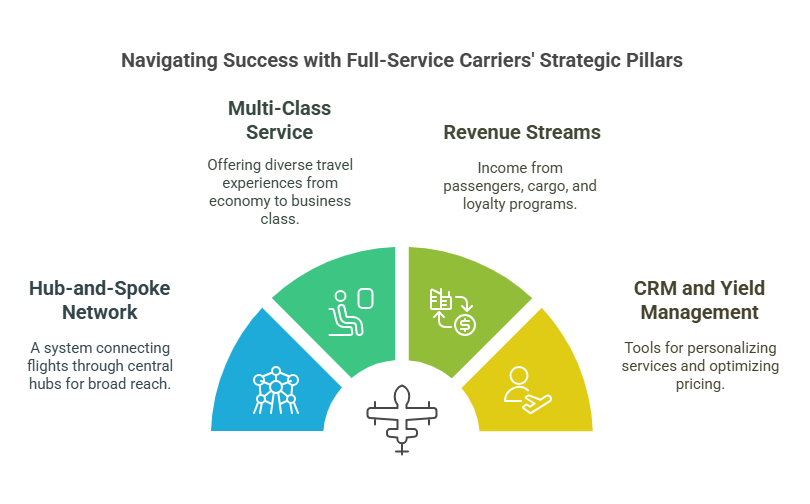
Full-Service Carriers (FSC): often known as legacy airlines or network carriers, are traditional airlines that offer a wide range of services integrated into the ticket price. They are designed to cater to various market segments, from economy-class travelers to premium and business-class passengers. FSCs typically operate on a hub-and-spoke network, allowing them to funnel traffic through key airport hubs and connect travelers to a broad array of domestic and international destinations.
- Operate a hub-and-spoke network
- Provide multi-class service and extensive in-flight offerings
- Earn revenue through passengers, cargo, and loyalty programs
- Use CRM and yield management systems for personalization and pricing
- Examples: Ethiopian airlines, British Airways, Lufthansa, Singapore Airlines
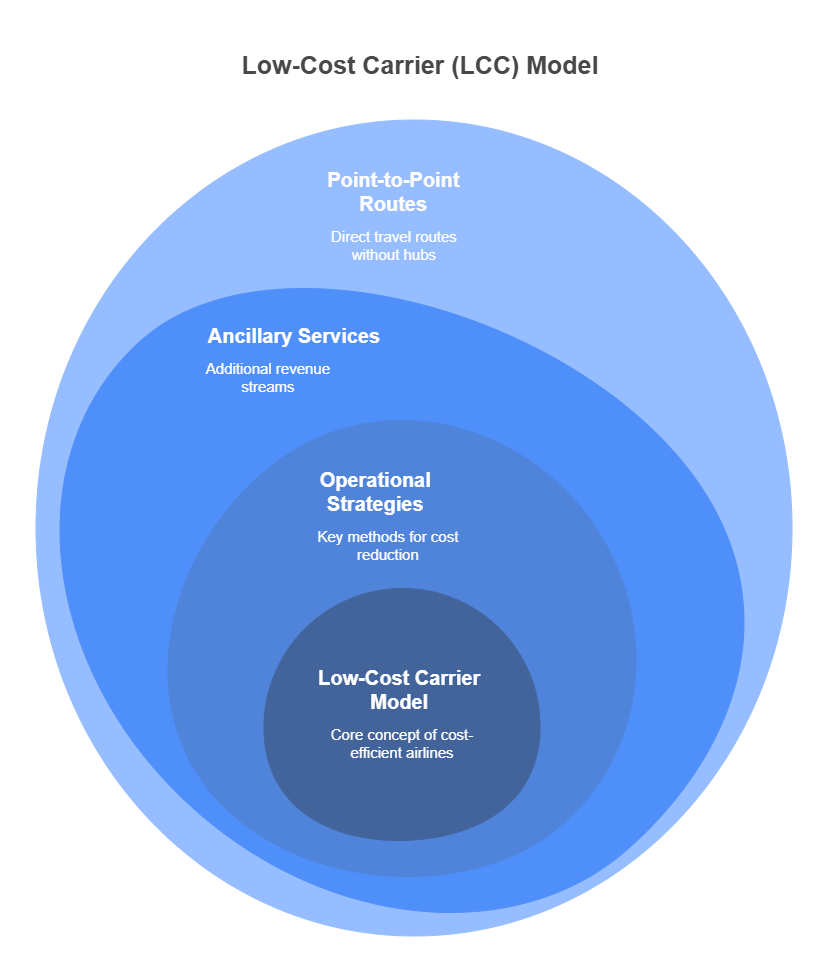
Low-Cost Carriers (LCC): are airlines that prioritize operational efficiency and cost reduction to offer affordable fares to the mass market. The LCC model emerged as a disruptive innovation, challenging traditional carriers by stripping away non-essential services and monetizing ancillary offerings such as baggage, food, and seat selection.
- Operate point-to-point routes
- Use secondary airports to reduce costs
- Single aircraft type for simplicity (e.g., Boeing 737)
- Revenue boosted by ancillary services like luggage fees, seat selection
- Examples: Southwest, Ryanair, easyJet
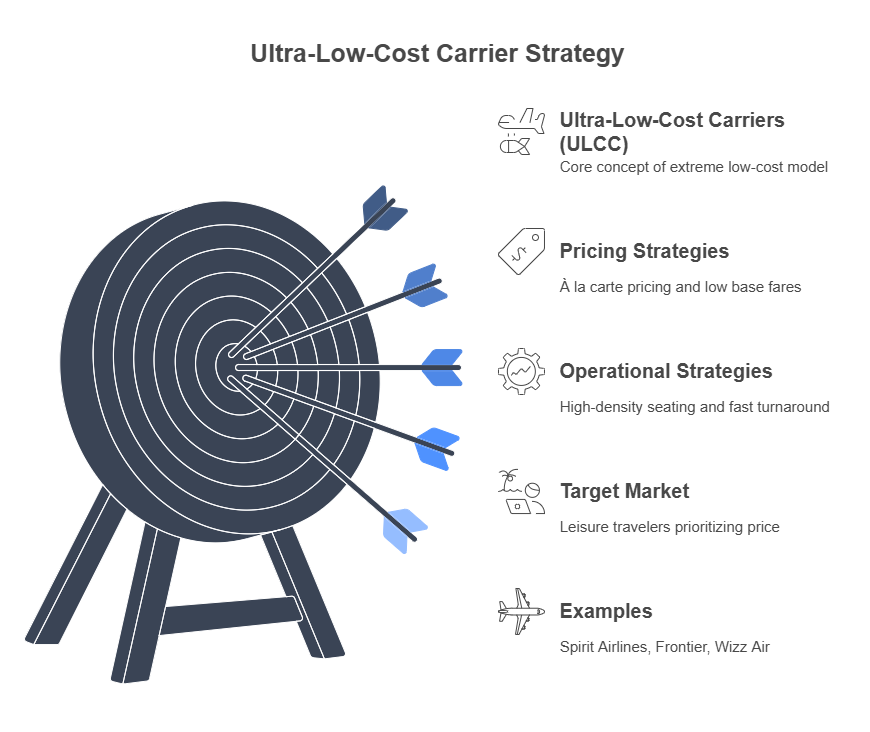
Ultra-Low-Cost Carriers (ULCC): take the low-cost model to an extreme by offering bare-bones ticket prices and charging for virtually every additional service. The goal is to maximize load factors and ancillary revenue per passenger while maintaining the lowest operational costs possible.
- Extremely low base fares with à la carte pricing
- Charge for bags, boarding passes, and even water
- High-density seating and fast turnaround times
- Examples: Spirit Airlines, Frontier, Wizz Air
ULCCs cater mainly to leisure travelers who prioritize price over comfort. They often use aggressive promotional pricing and operate from underserved or secondary airports to gain cost advantages. Prominent ULCCs include Spirit Airlines, Frontier, and Wizz Air.
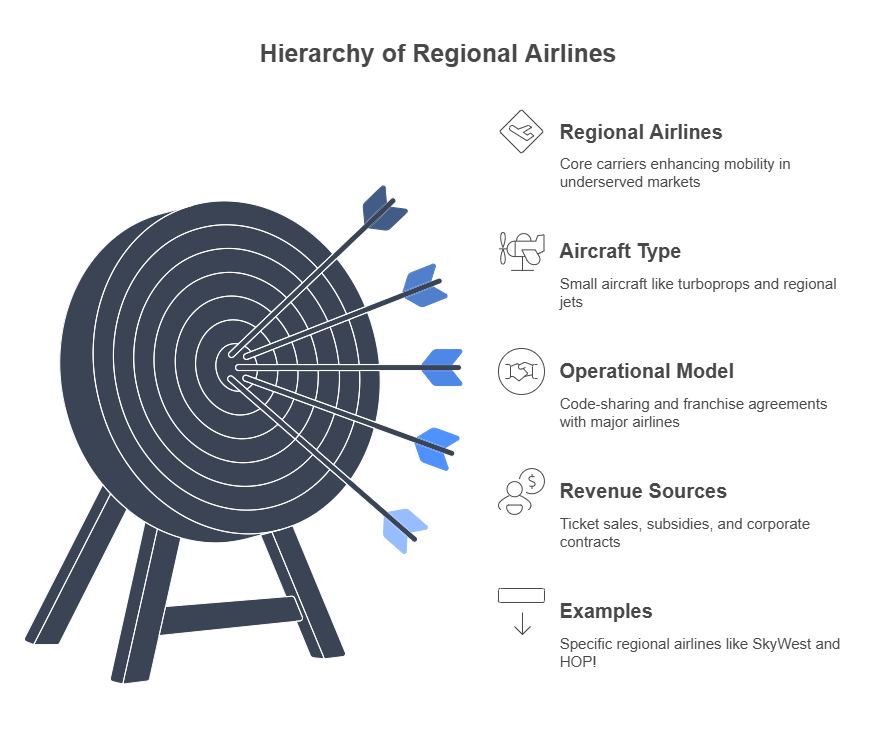
Regional Airlines: are carriers that operate short-haul flights connecting smaller communities to larger cities or hub airports. They serve a vital economic and social function by enhancing mobility in low-demand or underserved markets. These carriers are often contracted or affiliated with larger legacy airlines through code-sharing or franchise agreements.
- Use small aircraft such as turboprops or regional jets
- Often operate under brand names of major airlines (e.g., Delta Connection)
- Revenue sources include ticket sales, subsidies, and corporate contracts
- Examples: SkyWest, HOP!
Regional airlines may operate under a partner brand (e.g., United Express, Delta Connection) but are typically independent companies. Their smaller scale allows for lower operational costs and flexible scheduling, though they often rely heavily on subsidies and parent airline agreements to remain profitable.
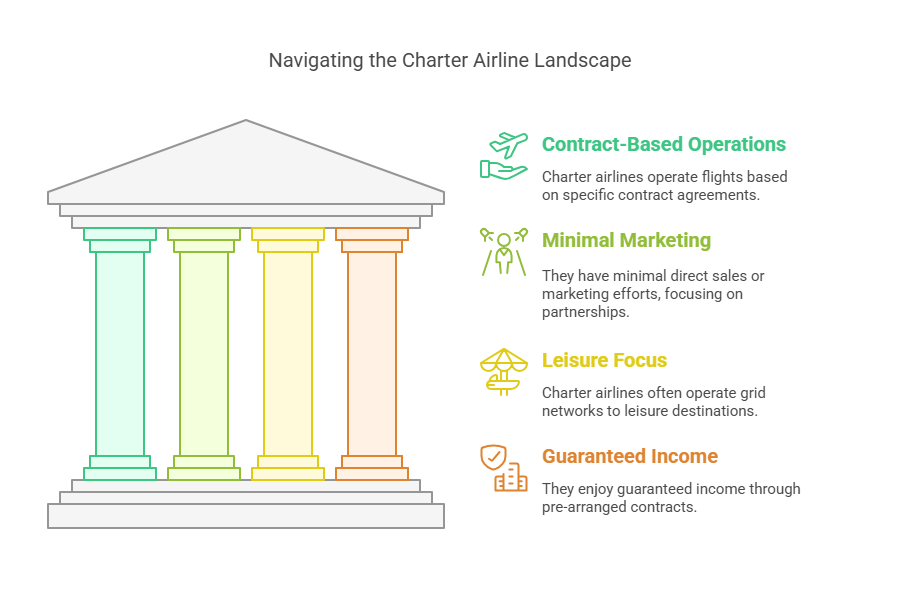
Charter Airlines Charter airlines operate non-scheduled flights based on specific contracts with tour operators, corporations, or other large groups. Unlike scheduled airlines, they do not publish regular timetables or sell tickets to the general public directly. Instead, they lease entire aircraft or blocks of seats to partners who then manage passenger bookings.
- Flights based on contract agreements
- Minimal direct sales or marketing
- Operate grid networks, often to leisure destinations
- Examples: Sunwing, TUIfly
While similar in structure to LCCs, charter airlines enjoy guaranteed income through pre-arranged contracts, reducing commercial risk. However, they are vulnerable to demand shifts in the tourism industry and often face intense competition for contracts. Examples include TUI Airways, Thomas Cook Airlines (prior to closure), and Sunwing Airlines.
Cargo Airlines: specialize in air freight transport, moving goods instead of passengers. These carriers form the logistical spine of global trade and supply chains, transporting items from parcels and medical supplies to industrial machinery and perishables.
- Operate freight-only aircraft
- Rely on volume contracts with shipping or logistics firms
- Run mostly night-time operations with high reliability
- Examples: FedEx Express, UPS Airlines, Cargolux
Some cargo airlines are independent (e.g., Cargolux, Atlas Air), while others are integrated with or subsidiaries of passenger airlines (e.g., Ethiopian Airlines, Lufthansa Cargo, Emirates SkyCargo). Demand is especially high during global crises, e-commerce booms, and high-demand shipping periods.

Niche or Specialty Airlines
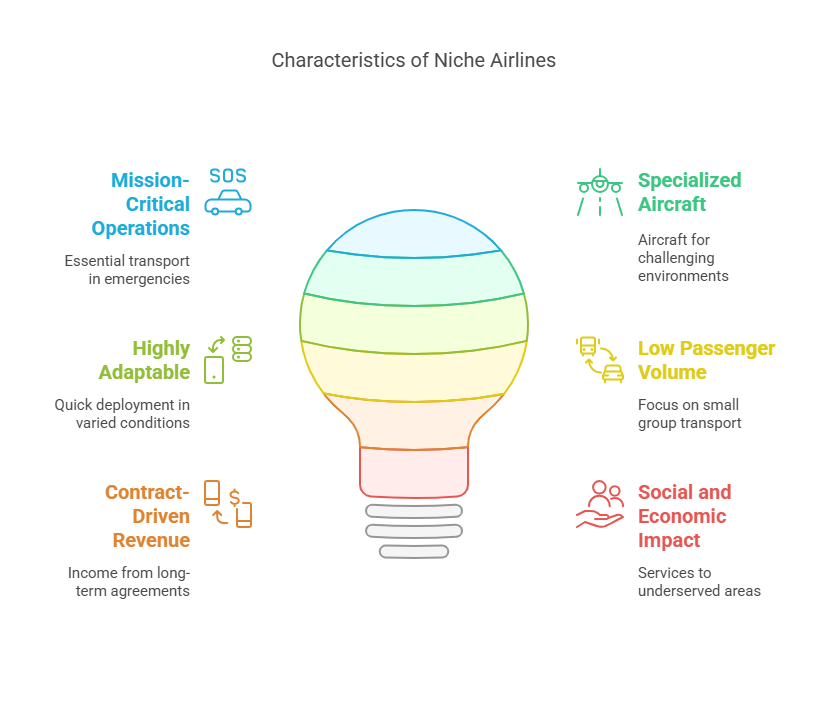
Niche or specialty airlines serve very specific markets or mission-critical functions that are underserved or overlooked by larger commercial carriers. These airlines typically operate in low-density, remote, or high-risk environments, fulfilling essential roles such as humanitarian relief, medical evacuation, disaster response, or government contracting.
Key characteristics:
- Mission-Critical Operations: Common missions include transporting medical personnel, emergency supplies, scientists, or aid workers to isolated or conflict-affected regions.
- Specialized Aircraft: Utilize STOL aircraft, helicopters, and modified jets capable of landing on short, unpaved, or hazardous runways.
- Highly Adaptable: Ready to deploy at short notice, often operating in rugged terrains or under unpredictable conditions.
- Low Passenger Volume: These carriers often carry small groups or even single individuals (e.g., medevac) rather than mass-market travelers.
- Contract-Driven Revenue: Income is typically sourced from long-term agreements with governments, NGOs, mining companies, or scientific institutions.
- Social and Economic Impact: Their operations play a crucial role in delivering services to underserved populations, often where no other form of transport exists.
Examples include
- Royal Flying Doctor Service (Australia) – medical transport in the outback
- Air Serv International – humanitarian missions in Africa
- Kenya Red Cross Aviation Unit – rapid response for disaster and aid
Though niche in nature, these airlines are invaluable for global resilience, emergency response, and regional development.
Integrator Airlines
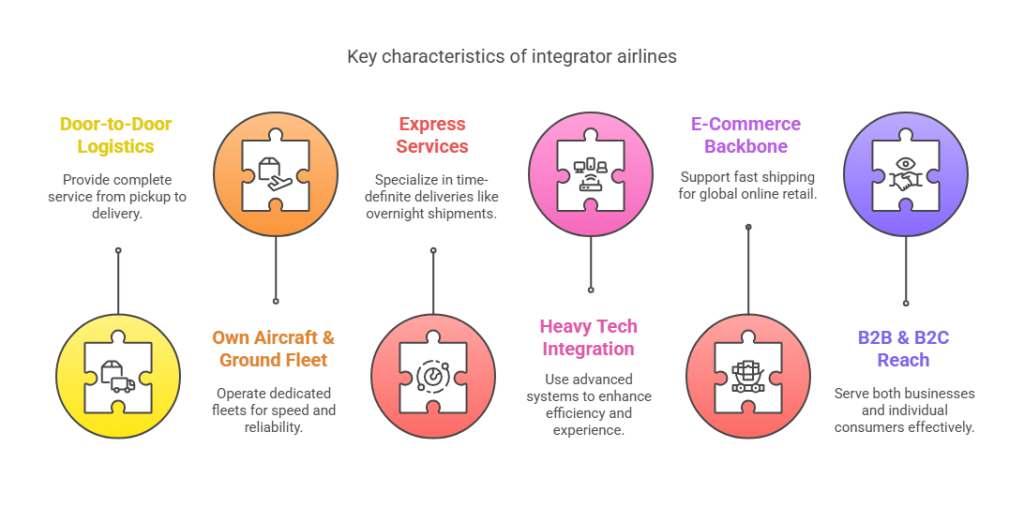
Integrator airlines are a unique breed of carriers embedded within end-to-end logistics organizations. Unlike standard cargo carriers, integrators manage every aspect of delivery—from pickup and sorting to air transport and final delivery—ensuring total control and accountability throughout the logistics chain.
Key characteristics:
- Door-to-Door Logistics: Provide complete service, not just airport-to-airport. Packages are tracked and handled through a closed-loop supply chain.
- Own Aircraft & Ground Fleet: Operate dedicated fleets of cargo aircraft, delivery vans, and sorting hubs to ensure speed and reliability.
- Express Services: Specialize in time-definite deliveries, such as overnight or next-day shipments.
- Heavy Tech Integration: Use advanced tracking systems, routing algorithms, and automated sorting to enhance efficiency and customer experience.
- E-Commerce Backbone: Integral to global online retail supply chains, supporting fast shipping for millions of parcels daily.
- B2B & B2C Reach: Serve both businesses and individual consumers, enabling international and last-mile fulfillment.
Examples of Integrators
- FedEx Express – Pioneered the overnight delivery model
- UPS Airlines – Supports logistics for retailers and manufacturers worldwide
- DHL Express – Known for international express shipping and real-time tracking
In today’s economy, integrator airlines have become indispensable to global commerce, particularly with the rise of e-commerce giants like Amazon and Alibaba relying on rapid delivery cycles.
Hybrid Airline Models
Hybrid airlines represent a strategic blend of full-service and low-cost models, aiming to offer the cost-efficiency of LCCs with added comfort and flexibility for modern travelers. These carriers adapt their offerings based on market demand, seasonality, and customer segmentation, appealing to both leisure and business customers.
Key characteristics:
- Fare Customization: Multiple fare classes (basic economy, standard, premium) with options to select or bundle services.
- Operational Flexibility: May operate a mixed fleet, combining long-haul and short-haul routes using both hub-and-spoke and point-to-point strategies.
- Partial Frills: Some free amenities (e.g., water, Wi-Fi) are offered while other services are chargeable.
- Loyalty Programs: Hybrid airlines maintain frequent flyer programs to foster loyalty while monetizing optional upgrades.
- Technology Investment: Emphasize digital experiences such as mobile check-ins, in-app purchases, and dynamic pricing algorithms.
- Target Audience: Appeals to cost-conscious travelers who still expect quality and comfort, particularly in mid-tier markets.

Examples include
- JetBlue Airways – Offers complimentary Wi-Fi and snacks alongside low base fares
- Norwegian Air Shuttle – Known for affordable long-haul transatlantic services with optional add-ons
- Alaska Airlines – Combines a regional footprint with a strong premium loyalty offering
The hybrid model thrives by adapting quickly to changing market preferences while keeping operational costs in check. It’s increasingly seen as the future blueprint for emerging airlines in competitive markets.
Comparison of Airline Business Models
| Model | Target Market | Network Type | Revenue Strategy | Key Strength |
|---|---|---|---|---|
| Full-Service | Business & Premium | Hub-and-Spoke | Tickets, Loyalty, Cargo | Global Coverage & Service |
| LCC | Budget Travelers | Point-to-Point | Ticket + Ancillary Sales | Affordability & Efficiency |
| ULCC | Price-Sensitive Travelers | Point-to-Point | Unbundled Fees | Lowest Base Fare |
| Charter | Tour Operators | Grid-Based | Group Contracts | Predictable Revenue |
| Cargo | Logistics/Freight | Freight Hubs | Volume-Based | Freight Specialization |
| Integrator | E-commerce, Businesses | Door-to-Door | Logistics + Parcel Fees | Full Supply Chain Control |
| Regional | Rural Travelers | Feeder/Grid | Fares, Subsidies, Partners | Local Connectivity |
| Hybrid | Value Travelers | Mixed | Blended Fare + Upsell | Flexibility + Comfort |
Airline business models are fundamental to how carriers operate and compete. Whether it’s full-service, low-cost, or highly specialized, each model is shaped by market demand, resource capabilities, and strategic intent.
As technology advances and customer expectations evolve, the lines between traditional categories are blurring. The most successful airlines in the future will likely embrace hybrid approaches, balancing cost control, operational flexibility, and customer experience.