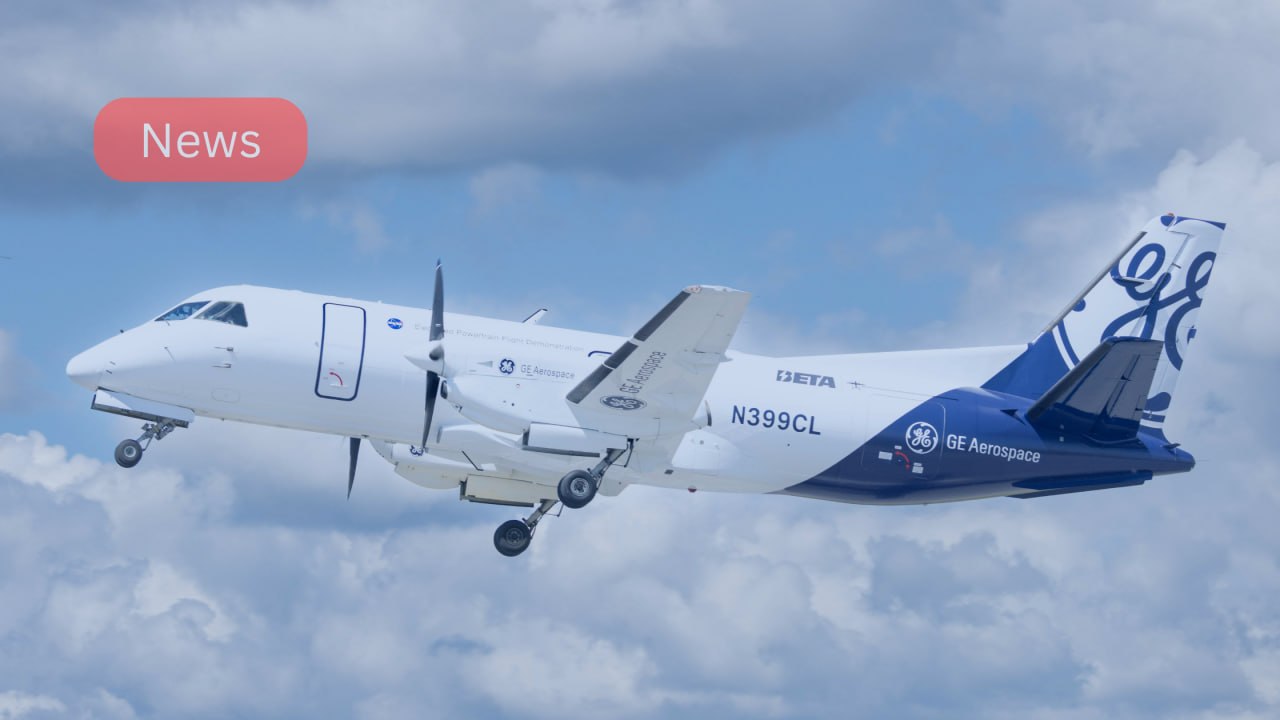

In a historic milestone for commercial aviation, GE Aerospace has successfully conducted the world’s first high-altitude flight assisted by a megawatt-class hybrid-electric propulsion system. Announced on July 20, 2026, at the prestigious Farnborough International Airshow, the test flight achieved altitudes exceeding 30,000 feet, the typical cruising level for commercial passenger jets.
Reporting from the event, Reuters journalists Tim Hepher and Shivansh Tiwary highlighted that after months of secret flight trials. The multi-flight test campaign, which began in May 2026, included a trans-Atlantic ferry flight from North America to the United Kingdom before its debut at Farnborough.
The breakthrough represents a core pillar of the industry’s push toward net-zero carbon emissions. Developed in collaboration with NASA, BETA Technologies, and Boeing, this integrated system proves that high-voltage hybrid-electric architecture can perform safely and reliably under real-world airliner operating conditions.
Breakthrough High-Altitude Hybrid Propulsion Test
The record-breaking test campaign utilized a modified Saab 340B regional turboprop testbed aircraft. Engineers replaced the starboard engine installation with an inverted nacelle housing GE Aerospace’s megawatt-class, multi-kilovolt hybrid-electric system mated to a standard CT7 engine.
During the flight campaign, the aircraft completed several long-duration test runs, with the longest continuous GE Aerospace hybrid electric flight lasting over two hours. Key milestones of the flight campaign include:
- 30,000+ Feet Altitude: Proved high-voltage electrical performance in thin, low-temperature atmospheric conditions.
- Trans-Atlantic Crossing: Demonstrated operational reliability during a multi-leg journey from the U.S. to England.
- Power Boost & Extraction: Successfully demonstrated the ability to draw electric power during climb and extract power to charge batteries during cruise.
“Simulation has given way to real-world innovation,” stated Mohamed Ali, Vice President and CEO of Commercial Engines at GE Aerospace. “This certainly becomes a significant enabling technology for the next generation of aircraft.”
Collaborators Behind the NASA EPFD Project
The flight campaign is the flagship achievement of NASA’s Electrified Powertrain Flight Demonstration (EPFD) project. NASA established this cost-sharing program to accelerate high-power hybrid-electric technology for commercial single-aisle airliners.
Multiple global aerospace pioneers contributed specialized subsystems to make the demonstration possible:
- GE Aerospace & Avio Aero: Developed the core electric motor/generators, power converters, inverters, and gearboxes.
- BETA Technologies: Acted as system integrator and provided flight test support alongside GE pilots.
- Boeing & Aurora Flight Sciences: Designed and manufactured the custom-engineered nacelle for optimum airflow and cooling.
- BAE Systems: Supplied the high-capacity energy storage battery pack.
BETA Technologies CEO Kyle Clark emphasized the milestone’s significance during a joint press briefing at Farnborough, noting that combining traditional gas turbines with electric motors leads directly to the next evolution in flight propulsion.
Sustainable Aviation Technology and the Path to Net-Zero
International air transport bodies, including the International Civil Aviation Organization (ICAO) and the International Air Transport Association (IATA), have committed to achieving net-zero carbon emissions by 2050. Because battery density remains insufficient to power large passenger jets on pure electricity alone, hybrid propulsion is considered the most viable near-term bridge.
By providing extra thrust during take-off and climb—when jet engines consume the most fuel—hybrid power systems allow core engines to be downsized and optimized for cruise efficiency. Experts estimate this hybrid architecture could reduce fuel burn and carbon emissions by 5% to 10% compared to traditional engines.
This technology directly feeds into the CFM RISE (Revolutionary Innovation for Sustainable Engines) program—a joint venture between GE Aerospace and Safran. CFM is developing open-fan and hybrid-electric technologies aimed at powering the eventual successors to the Boeing 737 MAX and Airbus A320neo families in the late 2030s.
Industry Outlook: What’s Next for Hybrid Electric Flight?
While the test is a major technical triumph, transition to commercial passenger service requires solving key engineering challenges. Airframe manufacturers like Boeing have highlighted potential concerns regarding system weight and cooling drag caused by extra air intakes needed for high-voltage electronics.
Over the coming years, GE Aerospace and its partners will analyze the vast amount of flight data gathered during the North Atlantic transit and Farnborough demonstrations. Future ground and flight trials will focus on further downsizing battery weight, refining power electronics, and integrating hybrid controls into full-scale open-fan architectures.
As rival engine producers like Pratt & Whitney and Rolls-Royce roll out their own hybrid research updates, GE Aerospace’s successful high-altitude flight establishes a strong benchmark for the future of sustainable aviation technology.







