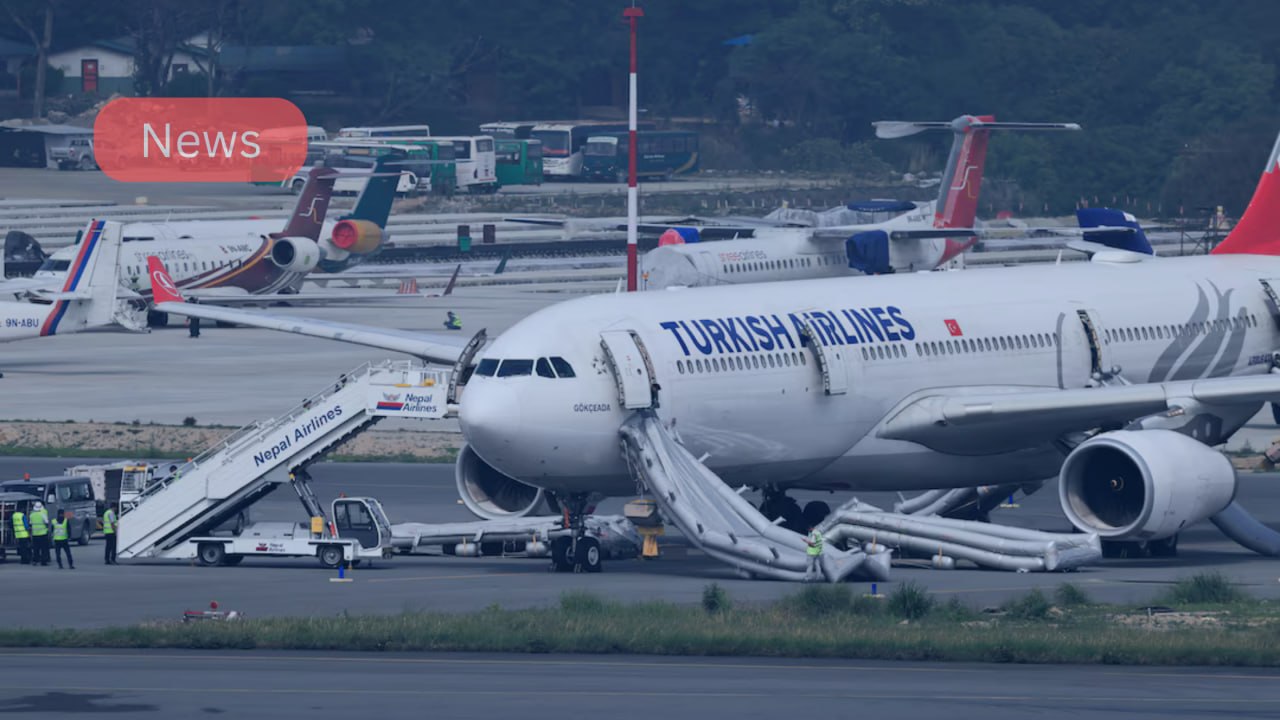

A Turkish Airlines Airbus A330 was evacuated at Tribhuvan International Airport on May 11, 2026, after smoke emerged from the aircraft’s landing gear during taxiing following arrival from Istanbul.
According to Reuters journalist Gopal Sharma’s report on the incident, all 277 passengers and 11 crew members exited safely using emergency slides. No injuries were reported.
Nepal’s Civil Aviation Authority initially stated that a fire broke out in the aircraft’s right rear tire. However, Turkish Airlines later said preliminary inspections suggested the smoke likely resulted from a hydraulic pipe malfunction rather than a major landing gear fire.
Turkish Airlines Kathmandu emergency evacuation disrupts airport operations
The aircraft involved was an Airbus A330, a widebody aircraft commonly used on long-haul international routes. Emergency crews responded immediately after smoke became visible during taxi procedures.
The incident temporarily shut down Kathmandu’s only international airport runway for approximately one hour while responders secured the aircraft and completed safety inspections.
Timeline of the incident
- Flight arrived from Istanbul to Kathmandu
- Smoke observed from landing gear during taxiing
- Emergency evacuation initiated
- Fire crews extinguished suspected tire-area fire
- Airport runway temporarily closed
- Aircraft moved to taxiway for inspection
- Turkish Airlines arranged replacement flight
Aviation safety response and regulatory procedures
The evacuation highlighted standard international aviation emergency protocols established by the International Civil Aviation Organization and supported through operational guidance from the International Air Transport Association.
IATA guidance emphasizes rapid passenger evacuation and immediate emergency response whenever smoke or fire risks emerge around aircraft systems.
Modern commercial aircraft crews receive recurrent simulator training for:
- Landing gear fire procedures
- Hydraulic system failures
- Passenger evacuation operations
- Airport emergency coordination
The incident also demonstrates the importance of airport rescue and firefighting capability at high-risk or geographically constrained airports such as Kathmandu.
Kathmandu airport remains under aviation safety scrutiny
Kathmandu’s airport operates in one of the world’s most challenging aviation environments due to mountainous terrain and rapidly changing weather conditions.
Nepal’s aviation sector has faced international scrutiny for years regarding operational oversight and airport infrastructure. Although this incident resulted in no fatalities, aviation analysts note that emergency preparedness remains essential in South Asian mountain aviation environments.
Associated Press confirmed that airport operations resumed after the aircraft was moved and inspections began.
Aircraft technical investigation underway
Turkish Airlines stated that technical teams immediately began inspections after the evacuation.
The airline’s communications executive, Yahya Ustun, said early findings pointed toward a hydraulic pipe malfunction that produced smoke near the landing gear assembly.
Hydraulic systems are critical to aircraft braking, steering, and landing gear operations. While smoke events can appear severe visually, aviation engineers note that emergency procedures are specifically designed to contain such risks before escalation.
At publication time, no final investigation report had been released by Nepalese authorities or international investigators.
Broader implications for airline operational safety
The Turkish Airlines Kathmandu emergency evacuation reflects the aviation industry’s increasing emphasis on rapid incident response and passenger survivability.
Global airlines continue to strengthen emergency management systems through:
- Enhanced aircraft diagnostics
- Improved airport firefighting coordination
- Real-time maintenance monitoring
- ICAO safety compliance programs
IATA data shows airlines increasingly prioritize preventive maintenance and operational risk management as passenger traffic continues recovering and expanding globally.
What’s Next for Turkish Airlines and Nepal Aviation Authorities?
Investigators are expected to examine:
- Landing gear condition
- Hydraulic system integrity
- Tire assembly performance
- Maintenance records
- Flight crew response procedures
The aircraft will likely remain grounded until technical inspections conclude and aviation authorities approve its return to service.
Industry analysts expect the final investigation to focus on whether the smoke originated solely from hydraulic system malfunction or involved secondary brake or tire overheating during landing operations.







