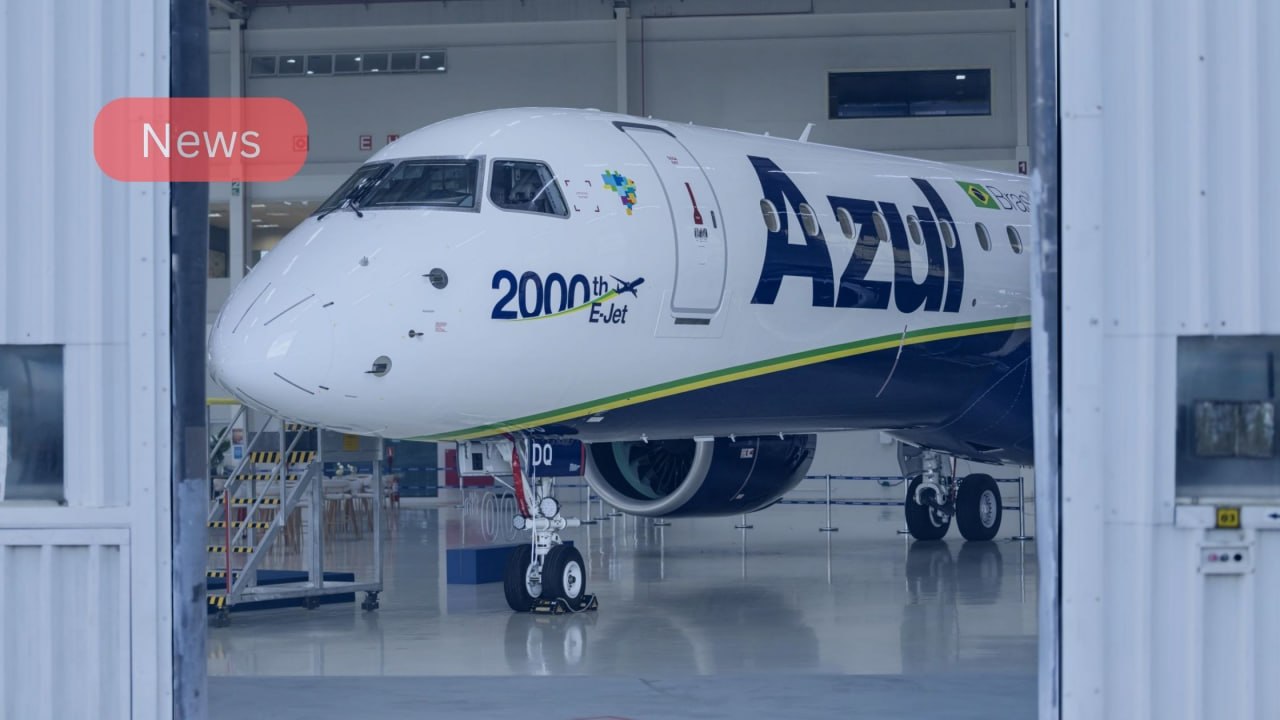

Embraer has reached a major commercial aviation milestone with the 2,000th E-Jet delivery, handing an E195-E2 to Brazilian airline Azul Linhas Aéreas on September 2, 2026. FlightGlobal reported the milestone the same day, while Embraer separately confirmed the delivery in an official company announcement. The accessible FlightGlobal version does not expose a verifiable author byline, so no individual journalist is attributed here.
The delivery took place at Embraer’s facilities in São José dos Campos, Brazil. The aircraft represents the latest generation of the E-Jet family and is also Azul’s 50th E2 aircraft. The milestone comes more than two decades after the first E-Jet entered commercial service in 2004.
Embraer E195-E2 reaches 2,000 E-Jet deliveries
The E-Jet family includes the first-generation E170, E175, E190 and E195, alongside the second-generation E190-E2 and E195-E2.
According to Embraer, E-Jets now operate with more than 90 airlines across more than 60 countries. The manufacturer says the fleet has accumulated approximately 48 million flight hours and carried more than 2.85 billion passengers.
The delivery also highlights the long relationship between Embraer and Azul. Azul began operations in 2008 with an E190 and later became the launch customer for the E195-E2. Embraer says the airline has operated more than 140 E-Jets since entering service.
Why the E2 aircraft matter to regional aviation
The E2 generation targets the market between smaller regional aircraft and larger narrowbody jets. The E190-E2 and E195-E2 are designed for airlines that need additional capacity while maintaining the economics required for routes that may not support larger aircraft.
Embraer markets the E2 family on its fuel efficiency, passenger comfort and operating economics. The company’s published specifications say the E2 can deliver up to 29% better fuel efficiency per seat compared with the previous generation, although such manufacturer figures depend on the comparison methodology and operating assumptions.
The commercial evidence shows that airlines continue to place orders for the aircraft. In July 2026, Embraer said its E2 program had exceeded 500 firm orders. Its commercial-aviation backlog reached $15.1 billion in the second quarter.
E-Jet deliveries coincide with continued aviation demand
The 2,000th delivery comes as global air travel continues to expand, although growth remains uneven between regions.
IATA reported that global passenger demand increased 0.2% year-on-year in July 2026. Latin American demand increased 6.1%, while African demand increased 5.2%. Domestic Brazilian demand increased 6.0% during the same month.
These figures provide wider context for aircraft manufacturers. Airlines continue to evaluate aircraft according to route demand, available capacity, operating economics and network requirements.
The E-Jet family’s market position is particularly relevant to this environment because its aircraft occupy a capacity segment below many conventional narrowbody aircraft.
E2 aircraft expand beyond the original regional-jet market
The E-Jet program began primarily as a regional-aircraft family. The E2 generation has broadened Embraer’s ambitions in the small narrowbody segment.
Recent orders illustrate this expansion. In September 2026, ANA Holdings agreed to purchase eight additional E190-E2 aircraft, increasing its firm E2 orders to 23. In July, Abra Group also announced an agreement covering 20 E195-E2 aircraft, with options and purchase rights that could bring the total to 45 aircraft.
These transactions do not guarantee future market share. They do, however, demonstrate continuing airline interest in the E2 family across different operating environments.
Aviation regulation and the E-Jet program
Aircraft deliveries also operate within a wider international safety framework.
ICAO Annex 8 establishes international Standards and Recommended Practices for aircraft airworthiness. These standards provide a basis for aircraft design, certification, production and continuing airworthiness, while national aviation authorities remain responsible for detailed certification and oversight.
This distinction matters because ICAO does not simply approve individual commercial aircraft for worldwide operation. National authorities apply their own airworthiness systems within the international framework.
For an aircraft manufacturer such as Embraer, international market access therefore depends not only on aircraft economics but also on certification, continuing airworthiness, operational approvals and regulatory acceptance.
What the 2,000th delivery means for Embraer
The milestone provides evidence of the E-Jet family’s longevity in commercial service. It also arrives during a period when Embraer is reporting strong demand for its newer E2 aircraft.
The company’s total backlog reached $34.5 billion in the second quarter of 2026, its seventh consecutive quarterly record according to Embraer. Commercial Aviation accounted for $15.1 billion of that backlog.
Those figures are company-reported and therefore should be read as corporate financial disclosures rather than independent market forecasts.
Industry Outlook
The next phase for the E-Jet program will depend on several factors:
- E2 order conversion: Firm orders and options will determine how quickly the second-generation fleet grows.
- Airline network strategies: Carriers will continue to assess whether smaller narrowbody aircraft can profitably serve thinner routes.
- Global passenger demand: IATA’s latest figures show continued growth but significant differences between regions.
- Certification and operational requirements: National authorities will continue to apply airworthiness and operational standards within the ICAO framework.
- Competition: Embraer will continue competing for the small narrowbody market while Airbus and Boeing remain dominant in larger narrowbody segments.
The 2,000th E-Jet therefore represents more than a production milestone. It marks the continued evolution of a commercial aircraft family that has moved from the regional-jet market into a broader role within global airline fleet planning.







